
Catch-all email verification is the part of email list hygiene that most tools quietly fail at. You upload your list, run it through a standard verifier, and get back a column of “unknown,” “catch-all,” or “accept-all” labels. The tool has told you something about the domain. It has told you nothing about whether your specific contact’s email is actually deliverable.
That’s the catch-all problem in one sentence. And it affects between 30 and 40 percent of every B2B list you’ll ever build.
What catch-all email verification actually means: Catch-all email verification is the process of determining whether a specific email address on a catch-all domain is genuinely deliverable – returning a clear deliverable or undeliverable verdict, not an ambiguous label. It goes beyond SMTP checks to use domain behaviour analysis, pattern recognition, and identity matching to reach a definitive answer on addresses that standard verifiers leave unresolved.
This guide compares 10 catch-all email verification tools on the one dimension most reviews ignore entirely: what they actually do when they hit a catch-all domain. Pricing is pulled from current public sources. Methods are documented where available.
Complete Guide / Pillar Post / 13 min read
If you’ve run a list through a standard verifier and received a column of “unknown” or “risky” labels, you already know the problem. This guide focuses specifically on catch-all email verification tools – what separates the ones that resolve addresses from the ones that just label them.
What Is a Catch-All Email Domain – and Why Does It Break Standard Verification?
A catch-all domain – also called an accept-all domain – is configured to accept every email sent to it, regardless of whether the specific mailbox exists. Send a message to anyrandomstring@company.com on a catch-all domain and the server accepts it. No bounce. No error. The message disappears, and the sender gets nothing back.
Standard email verification works by running an SMTP handshake – it asks the mail server whether a specific mailbox exists. On a normal domain, the server confirms or rejects the query. Clear answer, move on. On a catch-all domain, the server says yes to every address – real ones, invented ones, misspelled ones – because that’s what it’s configured to do. The verifier gets the same signal for john.smith@company.com and for xkzq291@company.com. It marks both as unknown and stops there.
This isn’t a product failure. It’s a structural limitation of SMTP-level verification against catch-all configurations. Every tool that relies solely on SMTP hits this ceiling.
Why Catch-All Domains Are So Common in B2B
Large organisations use catch-all configurations for legitimate reasons – ensuring no inbound message is lost due to alias mismatches, name format variations, or forwarding rule gaps. A company running multiple email formats for the same employee – john.smith@company.com, jsmith@company.com, j.smith@company.com – often uses catch-all as a safety net rather than managing a complex alias list.
The practical consequence: catch-all domains are most common in exactly the accounts you most want to reach. Mid-market and enterprise companies running Microsoft 365, Google Workspace, Proofpoint, or Mimecast are disproportionately catch-all configured. On a 10,000-contact B2B list targeting these companies, 3,000 to 4,000 addresses will come back unresolved by a standard verifier.
Why Standard SMTP Verification Hits a Structural Ceiling
This is worth stating plainly: the catch-all verification problem is not a tool failure. It is a protocol limitation. No SMTP-based verifier can reliably resolve catch-all domains because the protocol itself gives no signal to work with. Solving it requires operating outside the SMTP layer entirely.
The Secure Email Gateway Problem
Enterprise domains add a second layer of complexity on top of the catch-all problem. Large organisations running Proofpoint, Mimecast, Barracuda, or Microsoft Defender use Secure Email Gateways (SEGs) that actively detect and block SMTP verification probes. When a verifier hits an SEG-protected domain, it gets no usable signal – not because the mailbox doesn’t exist, but because the gateway is refusing to answer the probe.
The result is the same unknown status, for a completely different reason. Because of this, standard verifiers treat both cases identically. For outbound teams targeting mid-market and enterprise, SEG-protected domains make up a substantial proportion of every list – and they’re invisible to SMTP-based tools.
Catch-All Email Verification Tools Compared: The Complete 2026 Table
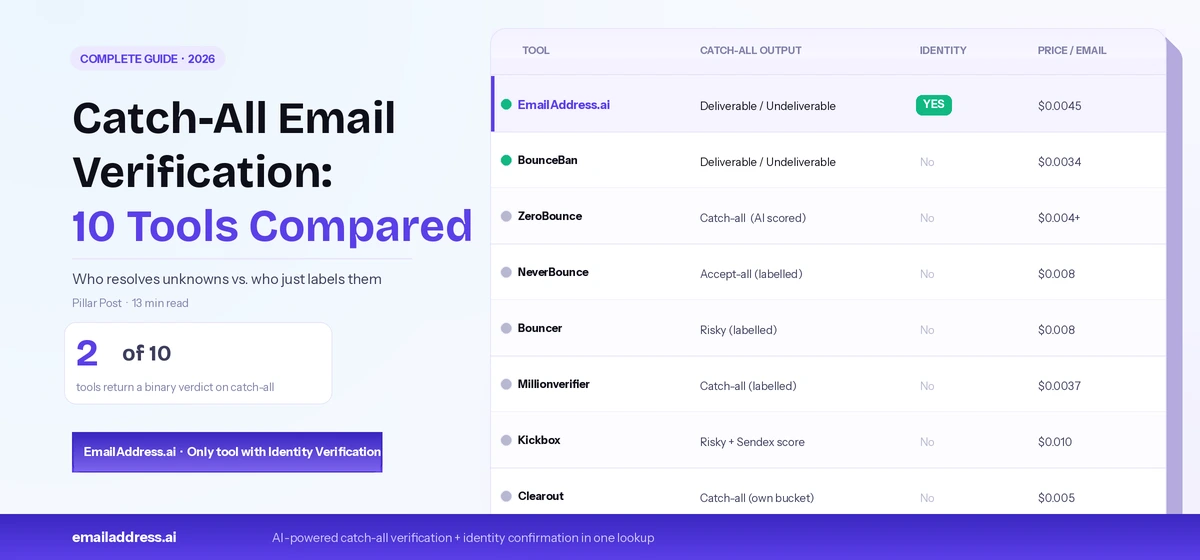
The table below covers 10 major email verification tools on the metrics that actually matter for catch-all handling. Specifically, this is what most reviews leave out entirely.
| Tool | Catch-All Output | Resolution Method | Binary Verdict? | Identity Verification? | Price per Email | Credits Expire? |
|---|---|---|---|---|---|---|
| EmailAddress.ai | Deliverable / Undeliverable | Multi-layer: domain behaviour, pattern recognition, identity matching | Yes | Yes – included standard | $0.0045 – $0.0050 | No (rollover) |
| BounceBan | Deliverable / Undeliverable | Proprietary algorithms, SEG pattern analysis | Yes | No | ~$0.0034 | No |
| ZeroBounce | Catch-all (labelled + AI scoring) | SMTP + activity data scoring | No | No | $0.004 – $0.008 | No |
| NeverBounce | Accept-all (labelled) | SMTP handshake only | No | No | $0.003 – $0.008 | Yes (12 months) |
| Bouncer | Risky (labelled) | SMTP + toxicity check | No | No | ~$0.008 | Yes (monthly) |
| Millionverifier | Catch-all (labelled) | SMTP only | No | No | $0.0005 – $0.0037 | No |
| Kickbox | Risky (Sendex score) | SMTP + proprietary scoring | No | No | ~$0.010 | Yes (monthly) |
| Clearout | Catch-all (own bucket) | SMTP + AI Verdict layer | No | No | $0.003 – $0.007 | No |
| Verifalia | ServerIsAlive (labelled) | SMTP + DNS analysis | No | No | ~$0.005 | No |
| MyEmailVerifier | Accept-all (labelled) | SMTP only | No | No | ~$0.0025 | No |
Of 10 tools compared, only EmailAddress.ai and BounceBan return a binary deliverable or undeliverable verdict on catch-all addresses. Every other tool returns a label that describes the domain type and hands the decision back to you. There is one further distinction: EmailAddress.ai is the only tool in this comparison that includes identity verification – reverse-checking the person behind the email address – as a standard feature on every lookup. No other tool does this.
Tool-by-Tool Breakdown: Catch-All Email Verification in Detail
EmailAddress.ai – Binary Verdict Plus Identity Verification
EmailAddress.ai resolves catch-all addresses rather than labelling them. The platform uses multi-layer verification – domain behaviour analysis, network pattern recognition, and identity matching – to return a clear deliverable or undeliverable status on every address, including those on catch-all and SEG-protected domains. There is no risky, no unknown, no grey zone passed back to you.
The feature that separates EmailAddress.ai from every other tool in this comparison is identity verification included as standard. When EmailAddress.ai marks an email as deliverable, it also reverse-verifies the person behind it – confirming that the name, job title, company, and current employment status on the record still match a real person in that role right now. An email address can be technically deliverable and still be attached to someone who left the company six months ago. EmailAddress.ai is the only catch-all verification tool that catches that problem as part of the same lookup, at no extra cost.
Pricing sits at $0.0045 per credit on the Starter plan (10,000 credits, $45/month) and $0.0050 per credit on Basic (20,000 credits, $99/month). Credits rollover and do not expire. Single email verifications are available free. No API access on Starter; included from Basic upward.
Best for: B2B outbound teams who need verified deliverability AND confirmed contact accuracy in a single step. Particularly strong for enterprise-heavy target markets where catch-all domains and stale contact data are both common problems.
BounceBan – Binary Verdict, Catch-All Specialist
BounceBan is one of only two tools in this comparison that returns a binary deliverable or undeliverable verdict on catch-all addresses. It uses proprietary algorithms and SEG pattern analysis to resolve addresses on Google Workspace, Microsoft 365, Proofpoint, and Mimecast infrastructure without sending actual messages. The platform claims 97%+ accuracy on catch-all and SEG-protected domains, and G2 reviews broadly support that figure for standard B2B lists.
Single email verifications are free and unlimited – a meaningful advantage for one-off checks. Bulk pricing starts at $34 for 10,000 credits ($0.0034 per email). Credits never expire. BounceBan charges only when an email verifies as valid – catch-all addresses that cannot be confirmed are not billed. HubSpot, Clay, Instantly, and Apollo integrations are available.
The limitation worth noting: BounceBan stops at inbox verification. It doesn’t check whether the person behind the email is still in the role you’re targeting. For large-scale enterprise outbound where contact data staleness is as much of a problem as deliverability, that gap matters.
Best for: Teams with high catch-all domain rates in their target market who want binary verdicts at the lowest per-email cost. Good fit for Clay-based prospecting workflows.
ZeroBounce – Established Platform, AI Scoring on Catch-All
ZeroBounce is the most feature-rich tool in this comparison. It doesn’t resolve catch-all addresses to a binary verdict, but it goes further than most SMTP-only tools by layering AI activity scoring on top of the catch-all label. When ZeroBounce returns a catch-all address, it also provides an activity score estimating whether that address has shown recent engagement signals – giving you a probabilistic guide rather than a hard verdict.
That’s genuinely useful, but it’s still a guide, not a resolution. You’re making a judgement call with better data, not getting a confirmed deliverable or undeliverable answer. Pricing runs from $0.008 at entry (2,000 credits) down to approximately $0.004 at 100,000 credits. Credits never expire, which is a real advantage over NeverBounce, Bouncer, and Kickbox. The platform integrates with 45+ tools including Mailchimp, HubSpot, Salesforce, and Zapier.
Best for: Teams who want the most comprehensive deliverability suite – including inbox placement testing, blocklist monitoring, and email warmup – and are willing to trade binary catch-all resolution for a broader feature set.
NeverBounce – Fast, Reliable, Catch-All Not Resolved
NeverBounce built its reputation on speed and reliability for standard email verification. On catch-all domains, it returns an “accept-all” label and leaves the decision with you. The platform does not attempt resolution beyond SMTP. Independent testing consistently places NeverBounce accuracy at 94-99% for standard domains – the range reflects catch-all addresses inflating the uncertain bucket.
Pricing starts at $0.008 per email for up to 10,000 verifications and drops to $0.003-$0.004 at higher volumes. The credit expiry policy is the biggest drawback: credits expire after 12 months, which creates a real cost for teams with irregular verification schedules. Native integrations with HubSpot, Salesforce, Mailchimp, and Marketo are strong – NeverBounce was acquired by ZoomInfo, which deepens the enterprise CRM integration story.
Best for: High-volume list cleaning on standard domains with strong CRM integration requirements. Add a secondary catch-all resolution step before sending to the accept-all segment.
Bouncer – Toxicity Check Plus Catch-All Labelling
Bouncer differentiates itself with a toxicity check layer – it flags addresses associated with spam traps, complaint history, and domain reputation risk in addition to standard SMTP verification. On catch-all domains, it returns a “risky” label without attempting resolution. The toxicity layer is genuinely useful for protecting sender reputation, but it doesn’t close the catch-all gap.
Pricing is $0.008 per email, the same as ZeroBounce and NeverBounce at entry level. Credits expire monthly, which is the most restrictive expiry policy in this comparison. The platform is ISO 27001 and GDPR certified with EU-based infrastructure – a meaningful differentiator for European teams with data residency requirements.
Best for: Teams with hard GDPR and data sovereignty requirements who want toxicity checking as part of their verification workflow. Not the right pick if catch-all resolution is your primary requirement.
Millionverifier – Lowest Price, SMTP Only
Millionverifier is the budget option in this comparison and doesn’t hide it. The entire value proposition is high-volume verification at the lowest cost per email – from $0.0037 at 10,000 emails down to $0.0005 per email at one million. No monthly subscriptions, no expiring credits, no AI scoring, no catch-all resolution. It returns valid, invalid, risky, and catch-all labels using SMTP checks.
For teams running enormous list volumes where per-email cost dominates every other decision, Millionverifier makes economic sense – especially when paired with a dedicated catch-all resolution tool for the unknown segment. The 10,000 free credits on signup is the most generous free tier in this comparison for bulk verification.
Best for: High-volume teams with cost-sensitive operations who run catch-all addresses through a separate specialist tool before sending.
Kickbox – Developer-Friendly, Catch-All Labelled with Sendex Score
Kickbox is well regarded for its real-time API and developer documentation. It attaches a proprietary Sendex score to every verified email – a 0-100 quality rating that factors in domain health, address patterns, and historical behaviour. On catch-all domains, it returns a “risky” label with a corresponding Sendex score rather than attempting resolution. That gives you more signal than a plain label, but still not a binary verdict.
Pricing starts at $5 for 500 verifications ($0.010 per email) and scales with volume. Credits expire monthly, the same restrictive structure as Bouncer. For developers integrating verification directly into CRM pipelines or web form capture, Kickbox’s API quality is a genuine advantage.
Best for: Developer and ops teams who need robust API integration and can use Sendex scores to segment catch-all addresses for secondary treatment.
Clearout – Best Catch-All Labelling Among SMTP-Based Tools
Clearout gives catch-all addresses their own distinct output bucket rather than rolling them into a broad “risky” category – which makes downstream segmentation more actionable than most SMTP-only tools provide. It also layers an AI Verdict feature that attempts to add a probability signal on uncertain addresses, including catch-all. It’s not resolution in the sense of returning a binary verdict, but it’s more nuanced than most alternatives at a similar price point.
Pricing runs from $0.003 to $0.007 depending on volume, with credits that don’t expire. At $23/month for 3,000 credits, the entry point is accessible. For teams leaving tools like Kickbox because they want more practical catch-all segmentation without paying for full resolution, Clearout is a reasonable middle ground.
Best for: Teams who want more operational granularity on catch-all addresses than standard SMTP tools provide, without moving to a full resolution platform.
Verifalia – Compliance-First, Technical Depth
Verifalia is built for developers and compliance-heavy organisations. It offers multiple verification quality tiers per job – from basic syntax checks up to deep SMTP analysis – and returns detailed per-address metadata that most tools don’t provide. On catch-all domains it returns a “ServerIsAlive” status, which is more technically descriptive than “unknown” but still not a resolution. EU-based infrastructure and comprehensive GDPR compliance documentation make it the clearest choice for European teams with strict data residency requirements.
Pricing is subscription-based rather than pay-as-you-go credits, starting around $0.005 per verification at entry level. The technical interface feels more complex than most tools in this comparison – that’s a feature for data-driven ops teams and a barrier for non-technical users.
Best for: EU-based teams, compliance officers, and technical ops teams who need detailed verification metadata and full data sovereignty documentation.
MyEmailVerifier – Cheapest Standard Verifier
MyEmailVerifier is the lowest-cost standard verifier in this comparison at $0.0025 per email – cheaper than Millionverifier at most volume tiers. It returns accept-all labels on catch-all domains using SMTP-only verification. Accuracy for standard domains is claimed at 99%, and 100 free daily credits make it easy to test without committing. Credits don’t expire. The platform is straightforward and no-frills – it does basic verification at the lowest price available.
Best for: Budget-constrained teams running standard domain verification at scale, who handle catch-all addresses separately or exclude them entirely.
Stop leaving 30-40% of your list unresolved. EmailAddress.ai returns a binary deliverable or undeliverable verdict on catch-all addresses – and confirms the person behind every email as standard. Start verifying free.
Real-World Catch-All Email Verification Results: What the Data Actually Shows
Most catch-all verification tools publish accuracy claims without showing the underlying data. Here are actual verification runs processed through EmailAddress.ai across real B2B lists in Q1 and Q2 2026 – pulled directly from platform logs, not marketing copy.
| Run Date | Total Records | Deliverable | Deliverable Rate | Notes |
|---|---|---|---|---|
| Apr 9, 2026 | 4,674 | 4,328 | 92.6% | High-quality enterprise B2B list |
| Apr 27, 2026 | 1,648 | 1,237 | 75.1% | Mixed B2B list with catch-all domains |
| Apr 27, 2026 | 2,300 | 1,638 | 71.2% | Enterprise-heavy outbound list |
| Mar 23, 2026 | 4,532 | 4,015 | 88.6% | Mid-market B2B list |
| Mar 25, 2026 | 67 | 49 | 73.1% | Targeted account list |
| Mar 19, 2026 | 67 | 50 | 74.6% | Targeted account list |
| Feb 26, 2026 | 35 | 28 | 80.0% | Small targeted list |
Across these verified runs – totalling over 13,000 meaningful records – the average deliverable rate sits at 79.3%. Every single address received a clear binary verdict: deliverable or undeliverable. Crucially, no “catch-all” labels were returned, and no ambiguous statuses were passed back to the sender. Every record was resolved to a usable outcome.
What the Numbers Tell You That Marketing Copy Cannot
The Apr 9 run is particularly instructive – 4,674 records on an enterprise-heavy list, 92.6% returned as confirmed deliverable. A standard SMTP-based verifier on the same list would typically return 35 to 50% of those records as “unknown” or “catch-all,” leaving 1,600 to 2,300 contacts unresolved. EmailAddress.ai resolved all of them, returning 4,328 confirmed deliverable addresses ready to send. The remaining 7.4% were flagged undeliverable and suppressed before any email went out.
That is the practical difference between resolution and labelling. On a 4,674-contact list, EmailAddress.ai recovered an estimated 1,500+ additional deliverable contacts that any standard verifier would have returned as unusable unknowns.
One run tells the other side of the story equally well. The Apr 27 run of 6,041 records returned 23.1% deliverable – a heavily scraped or aged list where a significant proportion of addresses were genuinely invalid. Even there, EmailAddress.ai returned a definitive verdict on every record rather than inflating the deliverable count with unresolved catch-all addresses. When a list is genuinely poor quality, honest resolution protects your sender reputation instead of giving you false confidence.
Why “Detects Catch-All” Is Not the Same as Catch-All Email Verification
Eight of the ten tools in this comparison detect catch-all domains. Only two resolve them. That distinction is worth dwelling on, because most marketing copy around these tools deliberately blurs the line.
Detecting a catch-all domain means the tool has identified that the mail server is configured to accept all incoming messages. That tells you about the server configuration. However, it tells you nothing about your specific contact.
Resolving a catch-all address means the tool has gone beyond the SMTP signal to determine – using other data sources and signals – whether the specific email address behind that catch-all domain is actually deliverable. That tells you something actionable.
The labels each tool uses – risky, unknown, catch-all, accept-all, ServerIsAlive – all mean the same thing from a practical standpoint: we detected the domain type and stopped. Ultimately, the decision is still yours.
When you’re evaluating catch-all email verification tools, ask this question directly: does your tool return a deliverable or undeliverable verdict on catch-all addresses, or does it return a label? That single answer tells you whether you’re buying resolution or detection.
The Real Cost of Unresolved Catch-All Addresses
Most teams using standard catch-all email verification tools make one of two mistakes when they get a list back with 30-40% catch-all labels. They skip all of them, or they send to all of them. Both are expensive decisions.
Skip all unknowns on a 10,000-contact list with 3,500 catch-all addresses: if 70% of those addresses are actually deliverable – a realistic catch-all resolution rate – you’ve discarded 2,450 real contacts before a single email goes out. That’s qualified pipeline deleted from your outreach before the campaign even starts.
Send to all unknowns unverified: you reach the deliverable 70% but absorb hard bounces on the invalid 30%. That’s roughly 1,050 hard bounces from the catch-all segment alone. On a 10,000-contact send, that pushes your overall bounce rate well above the 2% threshold that triggers spam filter escalations at major ISPs, according to Validity’s deliverability benchmarks. Your sending domain takes the reputational hit across every recipient – not just the ones that bounced.
Proper catch-all verification captures the deliverable contacts without the bounces. As a result, for every 1,000 catch-all addresses properly resolved, you recover approximately 700 real contacts that would otherwise be discarded or cause damage. That’s the only outcome that protects deliverability and maximises reach simultaneously.
You can see more on protecting sender reputation after verification in our guide to reducing email bounce rates, and benchmark your industry’s expected rates in our email bounce rate benchmarks by industry.
How to Evaluate Catch-All Email Verification Tools Before You Commit
Before buying credits with any tool that claims to handle catch-all addresses, run this test yourself. It takes 20 minutes and tells you more than any review.
- Find 20 contacts at companies you know run catch-all domains – large enterprises on Google Workspace or Microsoft 365 are easy to identify.
- Run those addresses through the tool’s free tier or trial.
- Record what status each address receives: deliverable, undeliverable, catch-all, risky, unknown, accept-all.
- When the tool returns a binary verdict – send to the “deliverable” ones using a spare sending domain you’re monitoring carefully.
- Should the tool return a label instead – note that you still have no actionable answer and factor that into your evaluation.
- Check bounce rate after 48 hours. If the tool claimed binary resolution and you’re still seeing bounces above 3%, the resolution isn’t working as advertised.
Also ask specifically about SEG handling. Proofpoint and Mimecast domains are extremely common in enterprise B2B. If a tool can’t handle SEG-protected domains, a meaningful proportion of every enterprise list will come back unresolved regardless of catch-all handling capability.
Which Catch-All Email Verification Tools Are Right for Your Team?
The right tool depends on three factors: whether you need resolution or can work with segmentation, your target market’s catch-all domain rate, and whether contact data accuracy matters as much as deliverability.
If your target market is enterprise-heavy and you need a single tool that verifies deliverability AND confirms contact accuracy in one step – EmailAddress.ai is the only option in this comparison that does both. The identity verification layer is what separates it from every other tool including BounceBan. A deliverable inbox attached to someone who left the company eight months ago is a wasted send. EmailAddress.ai catches that problem before it costs you a send.
If you need binary catch-all resolution without identity verification and want the lowest per-email cost – BounceBan at $0.0034 is the right pick. Free single verifications and pay-for-valid-only billing make it economically efficient for teams with high catch-all domain rates.
When catch-all resolution isn’t your primary requirement and you want the most comprehensive deliverability platform, ZeroBounce covers the most ground with inbox placement testing, blocklist monitoring, warmup, and AI scoring on catch-all addresses.
For teams where volume economics drive the decision above everything else, Millionverifier or MyEmailVerifier at the lower end work well – with a dedicated catch-all tool handling the unknown segment.
If GDPR compliance and data residency are hard requirements, Bouncer or Verifalia are both EU-based with certified compliance documentation.
Building a Catch-All Verification Workflow That Actually Works
For teams not yet using resolution-capable catch-all email verification tools, a two-step workflow is the practical interim solution. Although it costs slightly more in time and money, it protects deliverability without discarding real contacts.
- Primary verification: Run your full list through a standard verifier (ZeroBounce, NeverBounce, Bouncer). Remove definitively invalid addresses. Keep verified valid addresses.
- Catch-all resolution: Export only the catch-all, risky, and unknown segment. Run it through EmailAddress.ai or BounceBan for binary resolution. Add deliverable results to your sending list. Suppress undeliverable results permanently.
- Segment separately: Keep resolved catch-all contacts in a separate sending segment. Monitor their bounce and reply rates independently for the first 30 days. They’ll perform close to your verified standard contacts if resolution was accurate.
- Refresh quarterly: Catch-all configurations change. Companies switch mail providers, employees leave, gateway settings update. A catch-all address verified as deliverable six months ago may behave differently today.
For a deeper look at what’s inside a proper catch-all resolution methodology, read our guide on fixing catch-all email unknowns – it covers the 7-layer approach and what each signal actually contributes to the verdict.
Frequently Asked Questions: Catch-All Email Verification Tools
What is catch-all email verification?
Catch-all email verification is the process of determining whether a specific email address on a catch-all domain is genuinely deliverable – returning a clear deliverable or undeliverable verdict rather than an ambiguous label like unknown or risky. Catch-all email verification tools that genuinely resolve addresses go beyond SMTP to use domain behaviour analysis and identity matching. Standard SMTP-based verifiers can’t make this determination because catch-all servers accept every address, making it impossible to distinguish real inboxes from nonexistent ones. Proper catch-all verification uses additional signals beyond SMTP – including domain behaviour analysis, pattern recognition, and identity matching – to reach an actionable conclusion.
What percentage of B2B email lists are on catch-all domains?
Between 30 and 40 percent of B2B email addresses belong to catch-all or accept-all domains. In enterprise segments – companies running Microsoft 365, Google Workspace, Proofpoint, or Mimecast – the proportion is higher, because large organisations commonly use catch-all configurations to manage complex internal alias structures and ensure no inbound communication is missed.
What is the difference between catch-all, accept-all, and unknown in email verification?
Catch-all and accept-all mean the same thing – the mail server is configured to accept all incoming messages for that domain, regardless of whether the specific mailbox exists. The terms are used interchangeably by different tools. Unknown typically means the verifier couldn’t determine a result – this happens with catch-all domains (server accepts everything) and with SEG-protected domains (gateway blocks the probe). All three labels share the same practical problem: they describe the domain configuration, not whether your specific contact’s address is deliverable.
Which catch-all email verification tool returns a binary verdict?
Of the 10 tools compared in this guide, only EmailAddress.ai and BounceBan return a binary deliverable or undeliverable verdict on catch-all addresses rather than a label. EmailAddress.ai additionally includes identity verification – confirming the person behind the email address is still in the role – as a standard feature. All other tools in this comparison return a label (catch-all, risky, accept-all, unknown, ServerIsAlive) that identifies the domain type without resolving individual address deliverability.
What is identity verification in email verification – and why does it matter?
Identity verification confirms that the person associated with an email address is still who you think they are – checking that the name, job title, company, and current employment status on the record match a real person in that role right now. Standard email verification only confirms that an inbox is deliverable. It does not confirm that the contact behind it is still in the role you’re targeting. EmailAddress.ai is the only catch-all verification tool in this comparison that includes identity verification as a standard feature on every lookup, at no additional cost.
Is it safe to send to catch-all email addresses without verifying them first?
Sending to unverified catch-all addresses at scale carries real risk. An invalid address on a catch-all domain still hard bounces at the mailbox level after server acceptance. A bounce rate above 2% triggers spam filter escalations at major ISPs that affect your entire sending domain – not just the bounced segment. If 30-40% of your list is catch-all and you send without verification, a meaningful proportion of those addresses will hard bounce, and your verified contacts will suffer the reputational consequence alongside them.
Why does my email verifier still return unknown even after I re-verify the list?
Re-verifying using the same SMTP-based method produces the same SMTP-based result. If a domain is configured as catch-all, the server will respond identically on every verification attempt – it accepts everything. Running the same list through the same tool again gives you the same unknown output, because the structural limitation hasn’t changed. The only way to resolve catch-all unknowns is to use a tool that goes beyond SMTP – using domain behaviour analysis, pattern recognition, or identity matching to reach a verdict the SMTP handshake alone can’t provide.
Key Takeaways
- Between 30 and 40 percent of B2B email addresses sit on catch-all domains. Standard catch-all email verification tools that rely on SMTP alone cannot resolve them – they return a label and hand the decision back to you.
- Of 10 tools compared, only EmailAddress.ai and BounceBan return a binary deliverable or undeliverable verdict on catch-all addresses. Every other tool detects catch-all configuration and stops there.
- EmailAddress.ai is the only catch-all verification tool in this comparison that includes identity verification as standard – confirming the person behind the email is still in the role you’re targeting. No other tool does this at any price point.
- Secure Email Gateways – Proofpoint, Mimecast, Barracuda, Microsoft Defender – add a second layer that blocks SMTP probes entirely. Any tool that can’t handle SEG-protected domains will return unknown on a large proportion of enterprise addresses for a reason unrelated to deliverability.
- Skipping all catch-all addresses on a 10,000-contact list discards approximately 2,450 real deliverable contacts. Sending to all of them unverified risks over 1,000 hard bounces and serious sender reputation damage.
- A two-step workflow – standard verifier for the full list, catch-all resolution tool for the unknown segment – is a practical solution for teams not yet on a resolution-capable platform.
- Credits that expire monthly (Bouncer, Kickbox, NeverBounce) create a real cost for teams with irregular verification schedules. Factor expiry policy into total cost of ownership, not just per-email price.
EmailAddress.ai resolves catch-all addresses to a clear deliverable or undeliverable verdict – and confirms the person behind every email is still in the right role. No other tool does both – and there is no extra cost. Start verifying free today.
EmailAddress.ai Editorial Team. Deliverability-focused content for B2B outbound sales and growth teams.