
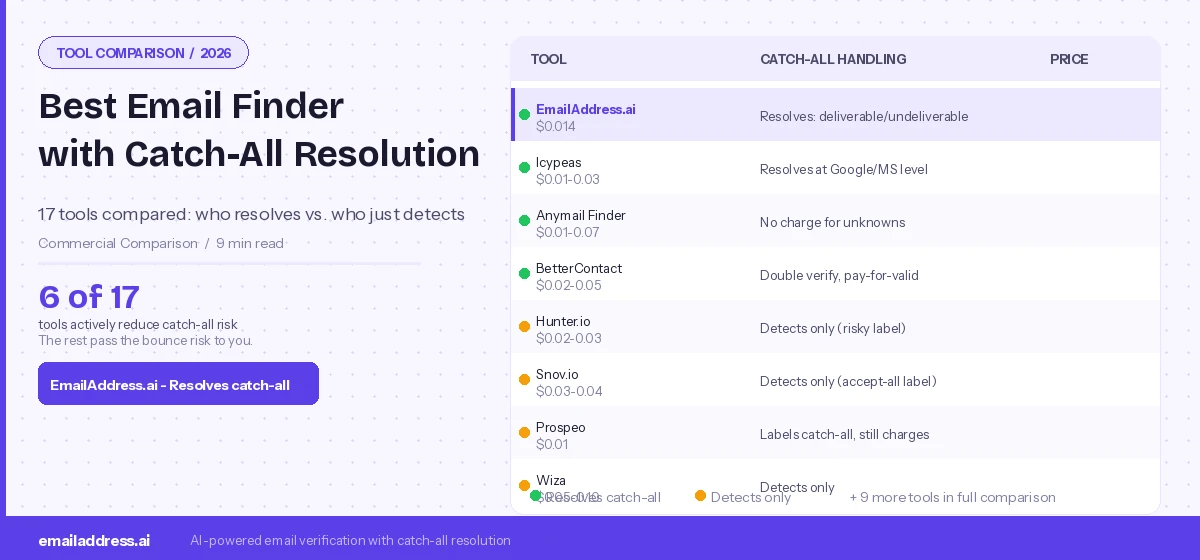
Finding the best email finder with catch-all detection sounds straightforward until you actually try to do it. Every tool on the market says it handles catch-all emails. But what they mean by “handles” ranges from “we flag it and move on” to “we actually tell you if the address is real.” Those are very different things, and the gap between them shows up directly in your bounce rate.
Here’s a scenario most outbound teams have lived through. You buy a list from an email finder, run your first campaign, and watch your bounce rate hit 15% inside 48 hours. You go back to the tool. It says the emails were “verified.” What it didn’t tell you was that half those addresses were on catch-all domains – and it had no way of knowing whether the specific mailboxes actually existed.
This comparison covers all 17 major email finder tools, what each one actually does when it hits a catch-all domain, and which ones give you clean deliverability rather than a false sense of security.
Quick answer: Most email finders detect catch-all domains but stop there. Only a handful go further and resolve whether the specific address is deliverable or not. EmailAddress.ai is one of the few that gives you a clear deliverable or undeliverable verdict on catch-all addresses, rather than handing the risk back to you.
Commercial Comparison / 9 min read
What Is a Catch-All Email – and Why Does It Wreck Your Campaigns?
A catch-all domain is set up to accept every message sent to it, regardless of whether the specific mailbox exists. Send an email to madeupname@company.com on a catch-all domain, and the server accepts it. No bounce. No error. Just silence, or a black hole inbox no one ever reads.
The problem for email finders is that standard SMTP verification works by asking a mail server whether an address exists. A catch-all server says yes to everything. So the tool marks the address valid. You send. Nothing happens – or worse, you get a delayed hard bounce that damages your sender reputation.
According to Validity’s email deliverability benchmarks, hard bounce rates above 2% trigger spam filter escalations at major ISPs. Catch-all leakage is one of the most common ways teams hit that threshold without realising it, because everything looked fine in the verification step. We cover this in more detail in our guide to reducing email bounce rates – but catch-all handling is where the problem almost always starts.
So when you’re evaluating the best email finder with catch-all detection, the key question isn’t whether the tool detects catch-all domains. Almost all of them do. The question is what it does next:
- Detects catch-all: The tool flags the domain as catch-all and returns the address as “risky” or “unknown.” You still have no idea if that specific inbox is real.
- Resolves catch-all: The tool goes further – using AI signals, behavioral data, and multi-source verification – to determine whether that specific address is actually deliverable. You get a real answer.
Most tools do the first. Very few do the second. That’s the entire reason this comparison exists.
The 17 Best Email Finder Tools with Catch-All Detection Compared
Here’s every major email finder currently on the market, ranked by how well they actually handle catch-all addresses. This is the one column most review sites leave out entirely.
| Tool | Catch-All Handling | Price per Email (USD) | Pay for Unknowns? |
|---|---|---|---|
| EmailAddress.ai | Resolves to deliverable/undeliverable | $0.014 | No |
| Icypeas | Resolves at Google/MS infrastructure level | $0.01 – $0.03 | No |
| Anymail Finder | No charge for unknown emails | $0.01 – $0.07 | No |
| BetterContact | Double verification, pay-for-valid model | $0.02 – $0.05 | No |
| Findymail | Filters out risky catch-all emails | $0.015 – $0.05 | Conditional |
| Dropcontact | Does not rely on catch-all guessing | $0.03 – $0.08 | No |
| Prospeo | Labels catch-all, does not resolve | $0.01 | Yes |
| Hunter.io | Detects catch-all, does not resolve | $0.02 – $0.03 | Yes |
| Snov.io | Detects catch-all, does not resolve | $0.03 – $0.04 | Yes |
| Tomba | Detects catch-all, does not resolve | $0.02 – $0.04 | Yes |
| AeroLeads | Detects catch-all, does not resolve | $0.02 – $0.05 | Yes |
| FindThatLead | Detects catch-all, does not resolve | $0.03 – $0.06 | Yes |
| SalesQL | Detects catch-all, does not resolve | $0.03 – $0.06 | Yes |
| GetProspect | Labels catch-all, charges valid only | $0.04 – $0.05 | No (for catch-all) |
| VoilaNorbert | Detects catch-all, does not resolve | $0.04 – $0.05 | Yes |
| Skrapp.io | Detects catch-all, does not resolve | $0.04 – $0.05 | Yes |
| Wiza | Detects catch-all, does not resolve | $0.05 – $0.10 | Yes |
Of 17 tools in this best email finder with catch-all detection comparison, only six take meaningful steps to reduce your catch-all risk. The other eleven hand the problem back to you with a label.
Best Email Finder with Catch-All Detection: Tool-by-Tool Breakdown
EmailAddress.ai – Best Overall for Catch-All Resolution
EmailAddress.ai doesn’t just detect catch-all domains – it resolves individual addresses within them. The platform cross-references AI-powered signals with multiple data sources to give you a clear deliverable or undeliverable verdict on each address, including those on catch-all domains. No “risky” middle ground. No grey zone you have to make a decision about.
At $0.014 per email, it sits comfortably in the mid-low price range, and you’re not charged for addresses it can’t verify. For anyone running cold email at scale, that combination – resolution plus no-charge-for-unknowns – is the cleanest setup in this comparison. Try EmailAddress.ai free and run your first catch-all batch before committing to credits.
Best for: Outbound sales teams, SDR managers, and growth marketers who can’t afford a bounce rate spike on their sending domain.
Icypeas – Best for Enterprise Domain Targeting
Icypeas takes a technically distinct approach. It resolves catch-all addresses at the Google Workspace and Microsoft 365 infrastructure level – which matters because the vast majority of enterprise domains run on one of those two platforms. Standard SMTP probing can’t access those infrastructure-level signals. Icypeas can. Pricing runs from $0.01 to $0.03 per email.
Best for: Outbound teams whose target market is heavily enterprise and likely running on Google or Microsoft mail infrastructure.
Anymail Finder – Best for Budget Catch-All Protection
Anymail Finder’s solution to catch-all is billing-based: if it can’t confidently verify an address, it doesn’t charge you for it. It returns an unknown status and moves on. You don’t resolve the address, but you also don’t pay for a problem you didn’t ask for. Pricing ranges from $0.01 to $0.07 depending on plan volume.
Best for: Teams on tighter budgets who want financial protection from catch-all unknowns without needing deep resolution capability.
BetterContact – Best for Agencies Needing Billing Accuracy
BetterContact runs every address through double verification across multiple sources and only charges you for emails it confirms as deliverable. Its catch-all handling is more conservative than EmailAddress.ai’s full resolution, but the pay-for-valid model makes it a practical choice when you’re managing client budgets carefully. Pricing sits between $0.02 and $0.05.
Best for: Agencies running campaigns for multiple clients where cost transparency and list quality both need to be tight.
Findymail – Best for Risk-Averse List Building
Findymail’s approach is to cut catch-all addresses out of your results entirely rather than passing them through with a warning label. Your list gets smaller, but cleaner. If you’d rather have 800 confirmed addresses than 1,200 with 400 unknowns mixed in, this is the right trade-off. Pricing runs $0.015 to $0.05.
Best for: Teams who prioritise list cleanliness over list size and don’t want to run a secondary verification step.
Dropcontact – Best for GDPR-Aligned Teams
Dropcontact is built differently to most email finders. It generates and verifies email addresses from GDPR-compliant public sources using pattern matching – it doesn’t scrape. Because it doesn’t rely on catch-all guessing as part of its verification logic, catch-all domains are less of a systematic problem. Pricing ranges from $0.03 to $0.08.
Best for: European teams with hard GDPR compliance requirements who want cleaner deliverability as part of the same workflow.
Hunter.io – Good Finder, Catch-All Resolution Not Included
Hunter.io is one of the most recognised email finders on the market. It detects catch-all domains and marks those addresses with a “risky” confidence score rather than a valid/invalid verdict. It won’t resolve whether the specific address is deliverable. At $0.02 to $0.03 per email, the pricing is competitive, but you’ll need a secondary verification step for any catch-all flagged contacts before sending.
Best for: Teams who already have a verification workflow and use Hunter primarily for discovery.
Snov.io – Best as an All-in-One Outreach Suite
Snov.io is better known as a full outreach automation platform than a pure email finder, which means catch-all handling isn’t its main focus. It detects catch-all domains and labels those addresses as “accept-all,” but resolution isn’t attempted. Pricing runs $0.03 to $0.04 per email.
Best for: Teams who want prospecting and sequencing in one platform and don’t need deep catch-all resolution.
Prospeo – Cheapest in the Comparison, Catch-All Not Resolved
At $0.01 per email, Prospeo is the lowest headline price in this comparison. It labels catch-all addresses in results but charges for them regardless of deliverability. If your target market has a low catch-all domain rate and you’re running secondary verification before sending, the cost advantage holds up. If you’re not, you’re paying for addresses that could bounce.
Best for: Price-sensitive teams who use a separate verification step before every send.
GetProspect – Billing Protection Without Resolution
GetProspect charges only for verified valid emails and shows catch-all addresses in results without billing them as valid contacts. You see the problem, you just don’t get it solved. Pricing is $0.04 to $0.05 for valid emails only.
Best for: Teams who want billing protection from catch-all risk and handle verification separately.
Tomba, AeroLeads, FindThatLead, SalesQL, VoilaNorbert, Skrapp.io, Wiza
These seven tools all detect catch-all domains and flag addresses accordingly. None attempt resolution. From a catch-all standpoint they’re operationally identical – detect, label, pass the risk back. Where they differ is in UX, integrations, LinkedIn enrichment, and CRM connectivity. Pricing ranges from $0.02 per email (Tomba, AeroLeads) up to $0.10 (Wiza, the most expensive tool in this comparison).
Best for: Teams whose target industries have naturally low catch-all domain rates, or who have a strong secondary verification workflow already in place.
Why Detection Isn’t Enough When You’re Choosing the Best Email Finder with Catch-All Detection
Here’s the practical version of this problem. You’re targeting a VP of Sales at a mid-size SaaS company. Their domain runs on Google Workspace with a catch-all policy – common in companies that set up blanket forwarding rules. Your email finder returns the contact with a “catch-all / risky” status.
Now you’re stuck. Send, and you risk a hard bounce that damages your domain reputation. Skip, and you’ve lost a qualified lead. Pay for a separate verification service, and you’ve added friction and cost for every contact on a catch-all domain. In some industries, catch-all domains make up 30% to 50% of all company infrastructure. That’s not a rounding error – it’s a substantial portion of your addressable market.
Tools that resolve catch-all addresses remove that decision entirely. The answer is binary: deliverable or not. That’s what the best email finder with catch-all detection should actually deliver.
For a deeper look at how catch-all verification works technically, read our guide on fixing catch-all email unknowns – it covers the SMTP mechanics and what resolution actually involves under the hood.
How to Test Any Email Finder’s Catch-All Handling Before You Buy
Don’t take a tool’s marketing at face value on this. Run the test yourself before committing to a paid plan.
- Find 10 contacts at companies you know use catch-all domains – large enterprises on Google Workspace or Microsoft 365 are easy examples.
- Run those contacts through the tool’s free trial or sample tier.
- Note the status each address gets back: valid, catch-all, risky, unknown, or undeliverable.
- Send a test sequence to the addresses returned as “valid” using a spare sending domain you’re monitoring closely.
- Check bounce rate and reply rate after 48 hours.
If “valid” addresses from catch-all domains bounce at more than 3%, the tool is not resolving catch-all – it’s labeling it and passing it through. That’s the honest test. And most tools in this best email finder with catch-all detection comparison fail it when catch-all domains are explicitly targeted.
You can use EmailAddress.ai’s catch-all verification to cross-reference addresses that another tool has flagged as risky. Run them through, get a resolved status, then send only the confirmed deliverable ones.
Want to see catch-all resolution in action? Run your first batch free on EmailAddress.ai – no credit card needed. Start verifying now.
Pricing Reality Check: What You Actually Pay per Deliverable Email
This is where headline pricing gets misleading. Per-email cost only tells you what you pay the tool. It doesn’t tell you what you pay in terms of bounced emails, damaged sender reputation, and wasted campaign spend.
Take Prospeo at $0.01 per email – cheapest in the comparison. If 25% of your target list is on catch-all domains and Prospeo charges for all of them without resolving any, your real cost per deliverable contact is meaningfully higher than a tool charging $0.014 that only bills you for verified addresses.
The right number to compare is cost per email that doesn’t bounce – not cost per email returned. Run the maths with your specific industry’s catch-all domain rate before making a decision based on the headline price alone.
Our email bounce rate benchmarks by industry can help you estimate what catch-all leakage is actually costing you before you switch tools.
Best Email Finder with Catch-All Detection for Cold Outreach: Priority Order
If you’re specifically choosing the best email finder with catch-all detection for cold email, here’s the order of criteria that actually matters:
- Catch-all resolution – does it go beyond detection and give you a real verdict?
- Billing model – do you pay for unknowns and catch-all flagged addresses?
- Data freshness – how frequently is the underlying database refreshed?
- Integration – does it connect directly to your sending platform or CRM?
- Price per verified email – real cost, not the headline number
On that framework, EmailAddress.ai, Icypeas, and BetterContact lead this group for cold outreach specifically. Tools that detect but don’t resolve – Hunter, Snov.io, Prospeo – still work well as part of a two-step workflow where you pair them with a secondary verification layer before each send.
What About GDPR and Email Finder Compliance?
If you’re sending into the EU or targeting EU-based contacts, data compliance is a separate layer on top of deliverability. Under GDPR Article 6, B2B email prospecting can use legitimate interest as a lawful basis – but the way that data was sourced matters. Tools that pull from publicly available professional data generally sit within legitimate interest grounds. Tools that scrape personal inboxes or rely on unconsented data purchases create a different risk profile entirely.
Dropcontact is built specifically for GDPR-aligned sourcing. Hunter.io, Prospeo, and EmailAddress.ai all publish their data sourcing methodology. If GDPR is a hard requirement for your team, read each tool’s data processing agreement before signing up – not just the privacy policy landing page.
Frequently Asked Questions: Best Email Finder with Catch-All Detection
What is the best email finder with catch-all detection in 2026?
The best email finder with catch-all detection for most outbound teams is EmailAddress.ai – it resolves catch-all addresses to a clear deliverable or undeliverable status rather than flagging them as risky. Icypeas is a strong alternative for teams targeting enterprise domains on Google or Microsoft infrastructure. If you need billing protection without full resolution, Anymail Finder and GetProspect are solid options at lower price points.
What is a catch-all email address?
A catch-all email address belongs to a domain configured to accept all incoming messages, regardless of whether the specific mailbox exists. Standard email verification can’t tell if the actual address is real on a catch-all domain, because the server accepts everything. That creates bounce risk for any outbound sender relying on verification results alone.
How do email finders detect catch-all domains?
Email finders detect catch-all domains by sending a test message to a mailbox that shouldn’t exist – a random string like xqz291@company.com. If the server accepts it, the domain is flagged as catch-all. The tool knows the domain setting, but still can’t tell whether your specific contact’s address is real. Detection and resolution are two separate capabilities.
Which email finder resolves catch-all emails rather than just flagging them?
EmailAddress.ai and Icypeas both attempt actual catch-all resolution. EmailAddress.ai uses AI-powered multi-source verification to return a deliverable or undeliverable verdict for catch-all addresses. Icypeas resolves at Google Workspace and Microsoft 365 infrastructure level. Findymail and BetterContact take a different approach – they filter catch-all addresses out rather than resolving them, which shrinks your list but keeps it clean.
What is a safe email bounce rate for cold outreach?
Keep hard bounces below 2% to protect your sender reputation with major ISPs. Above 2%, you risk spam filter escalations. Above 5%, your sending domain can get blocklisted. Unresolved catch-all addresses are one of the fastest ways to cross those thresholds without realising it until the damage is done.
Is it worth paying more for a best email finder with catch-all detection that resolves addresses?
Yes, if catch-all domains are common in your target market. Enterprise companies and domains running Google Workspace or Microsoft 365 frequently use catch-all configurations. If 20% or more of your target contacts sit on catch-all domains, the extra cost of resolution-capable tools pays for itself in deliverability savings and sender reputation protection within a few campaigns.
Can I use two email finder tools together to handle catch-all addresses?
Absolutely. A common approach is to use a cheaper finder like Prospeo or Hunter for initial discovery, then run any catch-all flagged addresses through EmailAddress.ai to get a resolved verdict before sending. It adds one step, but it’s a cleaner workflow than sending into catch-all unknowns and watching your bounce rate climb.
Key Takeaways
- Detecting a catch-all domain and resolving whether a specific address on it is deliverable are two different things. The best email finder with catch-all detection does both.
- Of 17 tools compared here, only EmailAddress.ai, Icypeas, BetterContact, Anymail Finder, Findymail, and Dropcontact take active steps to reduce catch-all risk beyond labeling it.
- Tools that detect but don’t resolve – Hunter.io, Snov.io, Prospeo, Skrapp.io, Wiza, and others – pass the bounce risk to you. That’s fine if you have a secondary verification step. It’s a problem if you don’t.
- Headline pricing per email is not the same as cost per deliverable email. Calculate the real number using your industry’s catch-all domain rate before deciding.
- Hard bounce rates above 2% trigger ISP-level spam filter escalations. Catch-all leakage is one of the fastest routes to that threshold.
- A two-tool workflow – a discovery finder plus catch-all resolution – is a practical and cost-effective approach for most outbound teams.
Stop guessing on catch-all addresses. EmailAddress.ai gives you a clear deliverable or undeliverable verdict – no risky labels, no grey zone, no wasted sends. Start verifying free.
EmailAddress.ai Editorial Team. Deliverability-focused content for outbound sales and growth teams.