
B2B intent data is behavioral information that reveals which companies are actively researching a problem your product solves, before they contact sales, before they fill out a form, and often before they even know which vendor they want to talk to. It tracks signals like content consumption, keyword searches, review site activity, and website behavior to help sales and marketing teams prioritize accounts that are actually in-market right now.
That’s the promise. And it’s a genuinely powerful one.
The reality is messier. The B2B intent data market hit an estimated $4.5 billion in 2026, growing at roughly 16% annually (DemandScience, 2026). Yet only 24% of organizations using intent data report exceptional ROI from it (DemandScience, 2026 State of Performance Marketing). The other 76% are drowning in noise, chasing accounts that were never going to buy, or sitting on a $50,000 annual subscription that nobody on the sales team actually checks.
We work with demand generation teams every day who have verified this pattern firsthand. They run intent-triggered sequences, watch the bounce rates spike, and realize the problem wasn’t the signal. It was that the contact data behind the signal had never been verified. But we’ll get to that.
This guide covers what B2B intent data actually is, how the three signal types work, the honest limitations nobody in the vendor space will tell you about, what real buying signals look like beyond content surges, and the one piece of infrastructure that determines whether any of this converts into pipeline.
EmailAddress.ai is an email verification and B2B contact data platform. This guide covers the intent data landscape independently. We have no commercial relationships with any of the providers listed below.
Last Updated: May 2026 | 14 min read | Guide
What Is B2B Intent Data? (The Actual Answer)
B2B intent data is a category of behavioral intelligence that captures signals indicating when a company or individual is actively researching a solution in your category. These signals range from content consumption on third-party publisher sites to visits on your own pricing page to review comparisons on platforms like G2 and TrustRadius.
The term is also used interchangeably with buyer intent data and purchase intent data; all three refer to the same underlying concept: reading behavioral breadcrumbs to identify who’s in buying mode before they raise their hand.
According to Forrester’s B2B buying research, 70-80% of the B2B buying journey happens before a prospect contacts a vendor. 6sense’s 2025 B2B Buyer Experience Report puts an even sharper number on it: 94% of buying committees have already ranked their preferred vendors before any sales conversation happens. By the time your SDR gets a reply, the shortlist may already be set.
Intent data attempts to give you a window into that invisible research phase. Instead of waiting for buyers to come to you, it surfaces who’s looking, so you can engage while opinions are still forming.
The challenge is that not all intent data is created equal. Not by a long shot.
What Is the Dark Funnel?
The dark funnel is the invisible portion of the B2B buying journey where buyers research solutions, compare vendors, and form preferences, all without any direct engagement with your brand. They read third-party reviews, consume analyst content, ask colleagues for recommendations, and evaluate competitors on sites you can’t see. Intent data exists specifically to illuminate this hidden activity. The limitation, as we’ll cover below, is that the illumination is often fuzzier than vendors admit.
The Three Types of B2B Intent Data: First-Party, Second-Party, and Third-Party
Understanding where intent signals come from is the single most important thing you can do before evaluating any provider or building any program. The source of the data determines its accuracy, its relevance, and whether it actually tells you what you think it does.
First-Party Intent Data
First-party intent data is behavioral information collected directly from your own digital properties: your website, product, email campaigns, chat tools, and content downloads. Pricing page visits, ROI calculator downloads, email click-throughs to your case studies: these are all first-party intent signals, and they are the most reliable you will ever get.
No inference is involved here. The behavior happened on your property, with your content, in response to your brand. That’s a fundamentally different level of certainty than inferring intent from anonymous browsing on a third-party publisher site.
Coverage is the limitation. First-party data only shows you accounts that already know you exist. For most B2B companies, that’s a fraction of the total addressable market. The vast majority of buyers researching your category haven’t found you yet, and first-party data is blind to all of them.
Second-Party Intent Data
Second-party intent data comes from partner platforms where buyers are engaged in explicit evaluation behavior. G2 Buyer Intent and TrustRadius Downstream Intent are the clearest examples. When a company reads reviews of competitors in your category on G2, that’s a second-party signal, and it’s a strong one, because the prospect is actively comparing vendors on a dedicated buying platform.
Someone browsing G2’s project management software category at 11pm is evaluating software, not casually reading industry news. That specificity makes second-party signals more actionable than topic surges. The trade-off is narrower coverage: you only see accounts actively using those specific platforms.
Third-Party Intent Data
Third-party intent data is what most people mean when they say “intent data.” It aggregates behavioral signals from across networks of external publisher websites, B2B media properties, analyst sites, and trade publications to identify companies researching specific topics above their normal baseline.
Bombora, which invented the category in 2014, is the reference standard here. Their Data Co-op currently tracks content consumption across nearly 6,000 B2B publisher and brand sites, monitoring 20,100+ intent topics via 16.6 billion monthly content interactions. When research activity around a topic cluster spikes significantly above a company’s historical baseline, Bombora flags it as a “Company Surge”: a signal that the account is in active research mode.
Forrester called Bombora “the gold standard for account-level intent data feeds” in its Q1 2025 Wave evaluation, and for good reason. Their consent-based, cooperative data collection model is more reliable than the bidstream approach used by competitors. Where bidstream providers eavesdrop on ad auction signals, a thin and often noisy data stream, Bombora’s publisher network explicitly shares anonymized reader behavior. That’s a fundamentally cleaner signal.
But even the best third-party intent data has a significant limitation that nobody selling it will lead with.
The Company-Level Problem: You Know the Building, Not the Room
Here’s the critical distinction that trips up most teams implementing intent data for the first time.
Almost all third-party intent data, including Bombora, is account-level, not contact-level. It tells you that “Acme Corp is surging on cloud security.” It does not tell you whether that’s the CISO running a formal vendor evaluation, the VP of Engineering doing background research for a board presentation, or a junior analyst Googling something for a Friday morning briefing.
This is the Barclays problem. Barclays has thousands of employees. If Barclays surges on data migration, you might be looking at a genuine enterprise deal, or a graduate intern writing a case study. You don’t know. The platform gives you 300 potential contacts to choose from and lets you figure it out yourself.
That “figuring it out” step is where most of the ROI disappears.
Contact-level intent data, which resolves signals to specific individuals rather than just organizations, attempts to close this gap. Some platforms are investing heavily in this direction, connecting behavioral signals to actual named contacts within target accounts. The challenge is that contact-level intent requires deterministic identity matching at scale, and the quality varies significantly across providers. Person-level intent data done well is genuinely valuable. Done poorly, it’s the same noise problem at a more granular level.
The practical approach most teams land on: use account-level intent data to identify and prioritize which companies deserve attention, then use verified contact data to determine which specific person at that company to reach.
Which brings us to a problem the industry has been dancing around for years.
The Uncomfortable Truth About Third-Party Intent Data
How the Data Pipeline Actually Works
If you’ve spent serious time building B2B databases, and we’re talking 15+ years, not months, you start to see the seams in how third-party intent data is actually constructed. And some of what you find is uncomfortable.
Here’s how the data pipeline works for many third-party intent providers: a publisher places a tracking tag on their website. That tag captures page-view activity. The traffic gets de-anonymized to a company via IP-to-organization matching. The content of the page gets mapped to relevant B2B topic clusters. When a company accumulates enough of these interactions around a cluster, they register as surging.
The problem: much of this publisher traffic is not B2B research. Someone at a company IP address reads a CNN article that happens to mention “AI agents” or “cloud migration.” That interaction gets counted. Suddenly their employer is scoring high for intent on topics that have nothing to do with any actual business need. You’re buying inference dressed up as precision.
Why the Problem Is Getting Worse
This structural flaw is getting worse, not better. As users increasingly shift their early research to LLMs, ChatGPT, Perplexity, Gemini, they’re bypassing the publisher network that intent providers rely on for signals. Research that used to happen on Gartner, TechTarget, and industry trade sites is now happening inside AI interfaces that traditional intent tracking can’t see. Bombora’s own data shows AI-driven search impacting certain publisher categories differently. They’re actively managing this shift, but it’s a real structural challenge for the entire category.
Relying on broad third-party signals as your primary outreach trigger means your sales team ends up chasing accounts that were never actually evaluating your category. That’s not a data quality problem you can solve by switching vendors. It’s a fundamental characteristic of how third-party intent data works at scale.
There’s a reason 31% of sales leaders in a widely cited survey called intent data “the most overrated technology in their stack.” Not because intent signals are useless (they’re not), but because the gap between what’s promised and what the data actually delivers hasn’t been acknowledged honestly enough by the industry.
What Actual Buying Signals Look Like
The most interesting development in B2B sales intelligence over the last two years isn’t a new intent data provider. It’s the shift from passive content-consumption signals toward “contextual signals” or “real-world trigger events”, behavioral evidence that doesn’t rely on inferring intent from anonymous page views.
Here’s what practitioners actually winning with intent data in 2026 are monitoring, layered on top of (or instead of) traditional third-party data:
Job Postings as Buying Signals
When a company posts a job opening, they’re making a public declaration of where they’re investing. Five new SDR roles almost certainly means new sales tooling within 90 days. A Head of RevOps hire signals a full tech stack audit is coming. Three engineering positions opening in a new geography means expansion, and expansion creates tool purchasing needs.
Reading content costs nothing. Opening a role costs real budget. Job posting data is one of the most reliable B2B buying signals available, and unlike most third-party intent, it’s publicly visible, current, and specific enough to personalize outreach around. “I saw you’re hiring six SDRs this quarter, which usually means you’re about to 3x outbound volume. We work with teams at exactly that inflection point” is a fundamentally different conversation opener than “I noticed your company is researching sales tools.”
Executive Hires and Leadership Changes
A new CRO in their first 90 days is one of the strongest buying windows in B2B. New executives evaluate existing vendors, bring preferred tools from previous companies, and need quick wins. Marketing stacks get audited when a new VP of Marketing arrives. Every SaaS line item gets scrutinized when a new CFO joins, and vendors often get consolidated or switched in the process.
Outreach tied to leadership changes generates significantly higher response rates than cold outreach, because the message is timely and directly relevant to something the prospect is already thinking about. The trigger makes the outreach feel less like interruption and more like good timing.
Funding Events
A company that just raised a Series B is expanding, hiring, and buying tools. The budget exists, the mandate exists, and the urgency exists. Funded companies typically lock in new vendor relationships within roughly three months of a round closing. Being first to engage, referencing the funding specifically, positions you at the front of the queue before competitors who are all watching the same Crunchbase alerts start spamming the same inbox.
Community and Forum Activity
Engineers asking hyper-specific integration questions in niche Slack channels or Reddit communities are further along in an evaluation than any content-surge score suggests. They’re not casually researching. They’re solving a specific technical problem, which means they’ve likely already decided on a direction and are working through implementation details. Monitoring relevant communities, selectively and not invasively, surfaces these signals before they ever appear in a traditional intent platform.
G2 and Review Platform Activity
Second-party intent from review platforms is the highest-signal external data available outside your own properties. When someone from a target account reads competitor reviews on G2 at 11pm, they’re not doing homework. They’re evaluating. Combine this with first-party engagement, they then hit your website two days later, and you have a pattern worth acting on immediately.
Technology Change Signals
A company ripping out a competitor’s tool is almost always in purchasing mode for adjacent solutions. Technographic data surfaces these moments: a company switching CRMs needs everything that integrates with their new CRM. A company dropping a point solution needs the capability that solution covered.
Account-Level Intent vs. Contact-Level Intent: Which Do You Actually Need?
The account-level vs. contact-level debate has become one of the more substantive conversations in intent data circles, and it’s worth addressing directly because the answer shapes which tools you invest in.
Account-level intent tells you that “someone at Acme Corp is actively researching solutions in your category.” It’s broad but actionable for campaign targeting, ABM prioritization, and deciding which accounts deserve SDR attention this week versus next quarter.
Contact-level intent resolves that signal to a specific individual: name, role, the topics they’re personally engaging with. It transforms “Acme Corp is in-market” into “the VP of Sales at Acme Corp has been reading content on CRM integration and just viewed two competitor comparison pages.” That’s a fundamentally different brief for outreach.
True contact-level intent at scale is genuinely hard. Probabilistic matching (statistical guessing based on device fingerprints) produces noisier data than deterministic matching (verified data connections). Always ask a vendor specifically which approach they use and what their match rate validation methodology looks like before committing.
For most B2B teams, the practical answer is a combination: use account-level signals for prioritization and campaign targeting, then rely on verified, accurate contact data to identify and reach the specific person most likely to be involved in the evaluation.
The Signal Is Only as Good as the Email Address Behind It
The Last-Mile Problem Nobody Talks About
You’ve done the hard work, identified a company that’s surging on your core topics. And you’ve layered in confirmation signals, a new hire, a relevant job posting, a G2 comparison page view from someone at that domain. Your SDR has a genuinely personalized message ready to go.
Then the email bounces.
Or it lands in a catch-all inbox that nobody monitors. Maybe reaches someone’s forwarded inbox who left the company six months ago and the MX record just absorbs it silently. Or, worse, it damages your sender reputation enough that your next fifty emails to legitimate prospects land in spam.
This is the last-mile problem of intent data activation, and it’s where a startling amount of intent data ROI disappears. The signal told you who to reach. The data told you their contact details. But if the email address isn’t deliverable, the entire chain breaks down.
Why Contact Data Decays Faster Than You Think
B2B contact data decays at a significant rate. People change jobs, get acquired, get restructured out. When you layer intent data on top of a contact database that hasn’t been verified recently, you’re not running a precision targeting program. You’re running a precision targeting program with a leaky pipe at the end of it.
We see this pattern consistently in our own data: across email lists built from intent-triggered outreach, catch-all addresses represent between 20-30% of total contacts. These addresses accept every incoming email at the server level, masking the fact that the individual mailbox may not exist. Standard bounce detection doesn’t catch them. Your SDR sends a carefully timed, personalized message, it clears the server check, and nobody ever reads it.
What we do at EmailAddress.ai
Email verification at the point of outreach, not just at list import, is what closes this gap. Catch-all email verification identifies these risky addresses before you send, protecting deliverability and ensuring your intent-triggered outreach actually reaches a real inbox.
EmailAddress.ai’s verification platform handles both standard email verification and catch-all detection, with real-time API access designed specifically for teams running signal-triggered outreach at volume. When an intent signal fires and your SDR is ready to move within 24-48 hours, the response window that separates pipeline from missed opportunities, the last thing you want is to discover the contact email is undeliverable after the fact.
There’s also a deeper fix for teams who want to close the contact quality gap entirely. EmailAddress.ai’s B2B and HCP contact data licensing gives intent-driven outreach a significantly stronger foundation than most contact databases provide. The data is refreshed in real time, focuses specifically on decision-makers and influencers rather than user-level contacts spread across an org chart, and has Active Inbox verification and catch-all detection built in as standard. When you combine that with intent signals, you’re not just knowing who is in-market. You’re reaching the right person at that account with verified contact data, rather than a best guess based on job title and a record last validated at list import.
Verify email addresses at the point of outreach, not at list import. B2B email bounce rates are a direct indicator of contact data quality, and high bounce rates damage sender reputation in ways that affect every email you send, not just the ones that bounced.
The Leading B2B Intent Data Providers: What Each One Actually Does
The market has split into distinct categories with different methodologies, price points, and use cases. Using the wrong category for your situation is a common and expensive mistake. Here’s how the leading platforms compare:
| Provider | Signal Type | Coverage Level | Price Range | Best For | Key Limitation |
|---|---|---|---|---|---|
| Bombora | Third-party content consumption | Account-level only | $30,000-$50,000/yr | Enterprise ABM with existing contact stack | No contact resolution; weekly batch delivery |
| 6sense | Multi-source predictive (Bombora + G2 + AI) | Account-level + buying stage prediction | $65,000-$130,000+/yr | Enterprise teams with full ABM programs | Black box scoring; high cost; steep learning curve |
| Demandbase | Intent + advertising + personalization | Account-level | Enterprise custom pricing | Multi-channel ABM with unified execution | Overkill for teams without full ABM motion |
| G2 Buyer Intent | Second-party review platform behavior | Account-level (some contact signals) | $10,000-$25,000/yr | SaaS companies; high-specificity signals | Narrow coverage; only G2-active accounts |
| TechTarget Priority Engine | Registered reader behavior on publisher network | Contact-level (registered users) | Custom pricing | Technology vendors targeting IT and security buyers | Limited to TechTarget publisher ecosystem |
| Apollo.io | LeadSift/Foundry signal tracking | Account-level + contact database | From $99/month | Teams under 20 reps needing signals + contacts in one tool | Lower signal quality than dedicated providers |
Bombora
Bombora is the category founder and the reference standard for third-party intent data. Their Data Co-op, nearly 6,000 publisher and brand sites sharing anonymized behavioral data, produces the broadest, most consent-based signal set available. Forrester named them a Leader in the Q1 2025 Intent Data Wave. Their Company Surge product identifies topic-level research spikes above historical baselines across 20,100+ B2B topics.
Bombora does coverage breadth well. Privacy-compliant data collection, deep integration with existing CRM and marketing automation platforms (Salesforce, HubSpot, Marketo, LinkedIn Ads), and the reliability of their baseline methodology are genuine strengths. Importantly, 86% of the data in their Co-op is shared exclusively with Bombora, which means competitors can’t replicate it.
What Bombora doesn’t do: tell you who specifically at the company is researching. It’s account-level only. You need a separate contact enrichment layer to identify the right person. Pricing starts around $30,000 per year, and weekly batch delivery means you may be acting on signals that are already several days old.
6sense
6sense combines multiple intent sources, including Bombora and G2, with AI-powered predictive modeling to estimate which buying stage an account is currently in: awareness, consideration, decision, or purchase. Rather than just surfacing who’s surging, 6sense attempts to predict who’s about to buy.
Gartner named 6sense a Leader in the 2025 ABM Magic Quadrant, and it earned that position. Cost is the challenge: median contracts are around $65,000 per year, and full platform activation often requires significant additional investment. Predictive models are powerful but operate as a black box; it can be difficult to understand why a specific account is being scored at a particular buying stage.
Demandbase
Demandbase combines intent data with advertising, website personalization, and account intelligence in a unified ABM platform. Tracking 500+ billion signals monthly across 300,000+ intent keywords, it’s best suited for enterprise teams running coordinated multi-channel ABM programs where the intent signal feeds directly into ad targeting, website personalization, and sales routing in one environment.
G2 Buyer Intent
For SaaS companies specifically, G2 Buyer Intent is often the most accurate external signal available. When a company actively compares your product category on G2, reading reviews, visiting comparison pages, checking pricing pages, they’re in explicit evaluation mode. The signal is narrow in coverage but high in specificity. G2 intent typically runs $10,000-$25,000 per year.
TechTarget Priority Engine
TechTarget operates one of the largest networks of B2B technology publisher sites and offers intent data based on registered reader behavior. Their signals are tied to known, identified professionals rather than anonymous IP addresses. This makes it particularly valuable for technology vendors targeting IT and security buyers specifically.
Apollo.io
Apollo bundles a version of intent data (sourced from LeadSift/Foundry signal tracking) with a contact database and sequencing platform. For teams under 20 reps who need intent signals, contact data, and outreach capability in one platform at an accessible price point, Apollo is often the practical starting point. The intent signal quality is lower than Bombora, but the cost-to-activation ratio is significantly better for smaller teams.
Why the First-Party Foundation Matters More Than Any Platform You Buy
Here’s the perspective shift that separates teams getting consistent ROI from intent data from teams perpetually disappointed by it.
Third-party intent data shows you what strangers are doing on other websites. First-party intent data shows you what prospects are doing on your website. That gap in signal quality is enormous.
A company visiting your pricing page twice, reading your integration documentation, and downloading your ROI calculator is sending you a clearer buying signal than any third-party surge score. The behavior is happening in your environment, in response to your brand, with your content.
Teams winning with intent data in 2026 share a common starting point: they’ve invested in first-party signal infrastructure before spending aggressively on third-party data. That means knowing which companies are visiting your website (website visitor identification), tracking which specific pages they’re consuming, understanding how that engagement relates to deal velocity, and building outreach workflows that fire when first-party signals reach a meaningful threshold.
Third-party intent data, Bombora, 6sense, G2, then works as a complement to this foundation, not a replacement for it. When a third-party surge signal and a first-party engagement event point to the same account in the same week, that overlap is a genuinely high-confidence signal. One signal is noise. Two signals from independent sources pointing to the same account at the same time is a pattern worth acting on immediately.
Teams struggling with intent data are typically doing the inverse: spending heavily on third-party signals while their own website tracking is rudimentary, their CRM has no behavioral data connected to it, and their outreach workflow is a weekly spreadsheet review rather than a real-time trigger system.
How to Actually Use B2B Intent Data for Sales and Email Outreach
Intent data is an input to a sales process, not a sales process itself. Teams that treat it as a list of warm leads to hand off to SDRs are the ones writing frustrated LinkedIn posts about why intent data doesn’t work. Teams that treat it as a prioritization signal that shapes timing and personalization are the ones hitting their numbers.
Here’s how the workflow actually looks for intent data for sales when it’s running correctly:
Step 1: Layer Signals, Don’t Act on Single Data Points
A single intent signal is a reason to pay attention, not a reason to call. An account visiting your pricing page once is interesting. The same account surging on Bombora for your core topic cluster, visiting your pricing page twice, and having a new VP of Sales join in the last 60 days is a pattern. That’s when you move.
Build scoring logic that weights combinations of signals: third-party topic surge plus first-party website behavior plus a contextual trigger (job posting, funding, executive hire) equals a high-priority outreach target. One signal alone, at a company that doesn’t match your ICP, equals noise.
Step 2: Match the Message to the Signal
One of the most common intent data implementation failures is using signal-based prioritization with generic outreach. You identify the right account at the right time and then send the same templated sequence you’d send to any cold prospect. The signal is wasted.
Know why an account is in-market, then say something relevant to that specific reason. If they’re researching data migration, your opener should reference data migration, not your product’s top three features. If they’re hiring SDRs, reference the challenge of scaling outbound with accurate data. Timing plus relevance is what converts intent signals into meetings.
Step 3: Verify Contacts Before You Send
Intent-triggered outreach operates on short timelines. Buying windows for surging accounts can be as short as two to four weeks. You don’t have time to discover mid-sequence that half your contact records are undeliverable.
Verify email addresses at the point of outreach, not at list import. High bounce rates damage sender reputation in ways that affect every email you send, not just the ones that bounced. Run verification before your sequence launches. Flag catch-all domains. Remove invalid addresses. This is the operational step most teams skip because it doesn’t feel like “intent data strategy,” but it’s often the reason intent data programs underperform.
Step 4: Set a Response Time Standard
Intent data has a shelf life. A buying window that’s two to four weeks wide doesn’t wait for your weekly SDR pipeline review. High-intent signals, a pricing page visit combined with a form fill, a G2 comparison event at a priority account, should trigger same-day outreach. Mid-tier signals can go into a 24-48 hour response workflow. Anything beyond that and you’re acting on stale data.
Step 5: Measure What Converts, Not What Surges
If you never track which signals actually led to meetings and which led to dead ends, your intent data program is running blind. The signal types that correlate with your closed-won deals are probably different from the signals that produce the most activity on your dashboard. Track the pipeline that intent-sourced outreach generates. Understand which signal combinations produce the best conversion rates. Trim the signals that produce noise. Double down on the ones that produce pipeline.
Building Your Own Signals When You Can’t Afford Enterprise Platforms
Enterprise intent platforms, 6sense, Demandbase, full Bombora deployments, require budgets that smaller teams simply don’t have. Some of the most accurate buying signals available don’t cost $50,000 per year. They require time and a bit of process.
LinkedIn Sales Navigator provides job change alerts, new hire notifications, and company headcount signals for saved accounts. Google Alerts and Crunchbase cover funding announcements and company news. Apollo.io bundles a lightweight version of intent signals with contact data at accessible price points. Website visitor identification tools like Warmly and RB2B surface which companies are engaging with your own content without requiring you to build a full ABM platform.
The playbook for a small team: pick 100-300 target accounts that genuinely fit your ICP. Set up alerts for the five to seven signals most predictive of buying behavior in your specific space, for most B2B companies, that’s executive hires, relevant job postings, funding events, and pricing or comparison page visits. Build a weekly review process. Reach out within 24 hours of a meaningful signal firing. Use the signal in your opening line.
That system, 300 accounts, five signals, same-day response, will outperform a poorly activated $75,000 intent data stack with a weekly spreadsheet review and a generic sequence.
Steal This: The Intent Signal Checklist
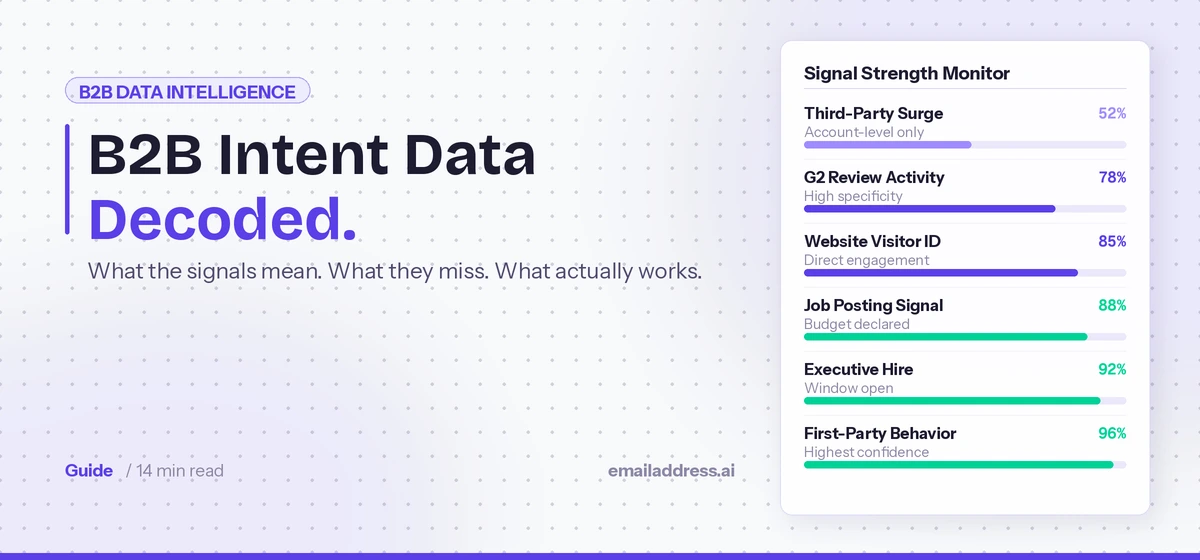
Use this checklist to build your signal monitoring stack. Screenshot it, copy it into Notion, or paste it into your RevOps playbook. These are the signals worth monitoring, ranked by confidence level:
- Pricing or demo page visit (2+ times in 7 days) – Highest confidence first-party signal. Act same day.
- G2 category comparison or competitor review read – High confidence second-party signal. Act within 24 hours.
- New C-suite or VP hire at target account – High confidence trigger event. Act within 48 hours of announcement.
- Series A/B/C funding announcement – High confidence trigger event. Act within 72 hours of round closing.
- 5+ relevant job postings in 30 days – Medium-high confidence. Signals budget and growth mode.
- Third-party Bombora/6sense topic surge – Medium confidence alone. Validate against items above before acting.
- Content download (whitepaper, ROI calculator, case study) – Medium confidence first-party signal. Add to nurture sequence.
- Community question in relevant Slack/Reddit (specific, technical) – Medium-high confidence. They’re already deep in evaluation.
Rule: Act immediately on signals 1-4. Layer signals 5-8 to validate before committing rep time. Never act on a single third-party surge signal alone.
Frequently Asked Questions: B2B Intent Data
What is B2B intent data?
B2B intent data is behavioral information that reveals which companies or individuals are actively researching a problem your product solves. It tracks signals like content consumption on external publisher sites, website visits, review platform activity, and search behavior to help sales and marketing teams identify and engage in-market accounts before they contact a vendor directly.
What is the dark funnel in B2B marketing?
The dark funnel refers to the portion of the B2B buying journey that happens invisibly, outside any direct engagement with your brand. Buyers research on third-party sites, read peer reviews, ask colleagues for recommendations, and compare vendors without ever visiting your website or filling out a form. Intent data attempts to illuminate this hidden activity by tracking behavioral signals across external publisher networks and review platforms.
What is the difference between first-party and third-party intent data?
First-party intent data comes from your own properties: website visits, content downloads, email engagement, product usage. It’s the highest-quality signal because it reflects direct engagement with your brand. Third-party intent data aggregates behavioral signals from across networks of external publisher sites, identifying companies researching topics related to your category across the broader web. First-party is more accurate but limited in coverage; third-party has broader reach but lower signal precision.
How does intent data work in B2B marketing?
Intent data platforms track behavioral events, page views, content downloads, keyword searches, review site comparisons, and aggregate them at the company level (account-level intent) or sometimes the individual level (contact-level intent). When a company’s research activity around a relevant topic cluster exceeds their normal baseline, the platform flags it as a surge signal. Marketing and sales teams use these signals to prioritize outreach, personalize messaging, and time engagement to when prospects are most likely to be receptive.
Is B2B intent data accurate?
Accuracy varies significantly by provider and methodology. Cooperative-based providers like Bombora, which collect consent-based data directly from publisher networks, produce more accurate signals than bidstream-dependent providers. Even the best third-party intent data has meaningful false-positive rates: one independent benchmark found roughly 81% accuracy for surge signals, meaning approximately one in five flagged accounts may not have genuine purchase intent. First-party and second-party signals (G2, TrustRadius) tend to be more accurate because they reflect explicit evaluation behavior rather than inferred interest from content consumption.
What is the difference between intent data and lead scoring?
Lead scoring typically uses firmographic data (company size, industry, geography) and engagement history with your brand to rank existing known contacts by fit and likelihood to buy. Intent data surfaces accounts that are actively researching your category, including companies you’ve never had any prior contact with. The two work best together: intent data identifies which unknown accounts deserve attention right now, while lead scoring helps prioritize the specific contacts within those accounts and sequence them against your existing pipeline.
How much does intent data cost?
Pricing varies widely. Bombora standalone intent data starts around $25,000-$50,000 per year. 6sense and Demandbase enterprise contracts typically run $65,000-$130,000+ annually. G2 Buyer Intent runs approximately $10,000-$25,000 per year. Apollo.io bundles a lightweight intent signal layer with contact data starting around $99 per month for small teams. Website visitor identification tools like Warmly and RB2B offer more accessible entry points at $10,000-$20,000 per year. Most enterprise platforms require annual contracts with no self-serve trial.
What are the best B2B intent data providers in 2026?
For third-party topic-level intent, Bombora is the established leader and the data source that powers many other platforms. In predictive ABM at enterprise scale, 6sense and Demandbase are the leading full-platform options. And for SaaS companies specifically, G2 Buyer Intent offers high-accuracy signals from explicit evaluation behavior. Plus mid-market teams needing signals plus contact data in one platform, Apollo.io is the most accessible starting point. For website visitor identification specifically, Warmly and RB2B offer real-time first-party signal capture at reasonable price points.
What does intent data mean for email outreach specifically?
Intent data identifies which accounts to contact and when. But the signal only produces pipeline if the outreach actually reaches a real inbox. Contact data decay means many B2B email addresses in even recently-built lists are no longer valid, people change jobs, companies restructure, and domains change. Running email verification at the point of outreach, not just at list import, ensures that intent-triggered campaigns don’t fail at the last step. Catch-all domain detection is particularly important here, as catch-all configurations silently accept email to any address at a domain, masking deliverability risk that standard bounce detection won’t catch.
Key Takeaways
- B2B intent data is behavioral intelligence that reveals which companies are actively researching your category, but the quality of that intelligence varies enormously based on data source and methodology.
- First-party signals are the highest-quality data you have. Build your own signal infrastructure before spending heavily on third-party platforms.
- Third-party intent data has real limitations. Account-level signals don’t tell you who at a company to contact. Much of the underlying data is inferred from consumer-context publishing activity, not pure B2B research. Signal latency means you may be acting on week-old data.
- Bombora is the category leader for third-party intent, consent-based, cooperative, and more accurate than bidstream-dependent competitors. But it still requires a contact resolution layer to act on effectively.
- Real buying signals go beyond content surges. Job postings, executive hires, funding events, and community activity are often more actionable and more accurate than third-party topic surge data alone.
- Layering signals beats single data points. One signal is noise. Two or three independent signals pointing to the same account at the same time is a genuine buying indicator.
- The last mile determines ROI. Intent data tells you who to reach and when. Verified, deliverable email addresses determine whether you actually get there. Running email verification before intent-triggered outreach is the operational step that closes the loop.
Key Sources
- DemandScience, 2026 State of Performance Marketing Report (750 senior marketing leaders surveyed)
- 6sense, 2025 B2B Buyer Experience Report (94% buying committee stat; buying stage data)
- Forrester, The Forrester Wave: B2B Intent Data Providers, Q1 2025 (Bombora “gold standard” citation)
- Bombora, Data Co-op Documentation and AI Impact Report, 2026 (Co-op size, topic taxonomy, AI-driven search impact data)
- Gartner, 2025 Magic Quadrant for Account-Based Marketing Platforms (6sense and Demandbase Leader placement)
Ready to make sure your intent-triggered outreach actually lands? Verify your contact list with EmailAddress.ai before your next campaign, and stop letting signal-sourced pipeline disappear at the last step.
About EmailAddress.ai: EmailAddress.ai is an email verification and B2B contact data platform, processing millions of email verifications monthly for demand generation teams across SaaS, pharma, and enterprise sales. Our B2B and HCP contact data is refreshed in real time with Active Inbox verification and catch-all detection built in as standard.