
Last Updated: June 2026 | 13 min read
Most conversations about HCP data start in the wrong place. They start with database size, specialty counts, and accuracy percentages. Those things matter. But the more useful conversation starts with a simpler question: did the email get delivered? Did the physician actually receive it? Because that counts as the only signal when a pharma marketing team or medtech sales rep needs to run a campaign.
We work with healthcare commercial teams every day. What we see constantly is the same pattern: a team buys a physician list, sends a campaign, and watches bounce rates climb past 20%. Then comes the attribution problem. Was it the data? The domain? The catch-all verification tool that said every address was valid? Usually it is all three – but the data almost always drives the breakdown.
This guide covers both sides of the HCP engagement problem: why physician contact data fails at the point of use, and what a real HCP engagement strategy looks like when you build it on data that teams have verified.
What Is HCP Data and Why Does It Break So Often?
HCP data covers verified contact information for licensed healthcare professionals – physicians, nurse practitioners, specialists, and clinical decision-makers. Pharma and medtech commercial teams use HCP data for outreach campaigns, territory planning, and account-based marketing. The best HCP data combines NPI-verified identity, validated email addresses, specialty classification, and practice setting in a single record.
Most providers confuse collection with verification. They assemble physician records from directories, scraped sources, and licensed third-party feeds. Then they run a basic SMTP check on the email address and call it verified. But SMTP validation does not tell you whether a physician is still practicing at that location. It does not tell you whether that hospital domain accepts every incoming message regardless of whether the inbox exists. And it does not tell you whether the NPI on that record is still active.
You get a list that looks clean. So you send your campaign. The bounces tell you the real story.
Why does physician email verification fail at hospital domains?
Hospital and health system domains frequently run as catch-all servers. A catch-all domain accepts every incoming email at the server level – so SMTP verification returns a valid result on every address, even ones tied to physicians who left that institution two years ago. Standard verification tools cannot distinguish between an active inbox and a ghost address on a catch-all domain. The only real verification signal comes from actual send data: sending the email and measuring what happens. EmailAddress.ai builds its catch-all verdict on exactly that – send-level observation data layered on top of NPI-confirmed identity, producing a binary deliverable or not deliverable verdict rather than a confidence score that shifts the risk back onto you.
Three Different Things Buyers Call “HCP Data” (And Why It Matters)
One of the most expensive mistakes in healthcare commercial strategy is buying the wrong type of HCP data for the job. The market uses “HCP data” to describe at least three distinct product categories, and they do not do the same thing.
Prescribing analytics and market intelligence platforms – IQVIA OneKey, Definitive Healthcare, Veeva OpenData – handle CRM reference data, claims analysis, procedure volume tracking, and formulary intelligence. These are enterprise compliance tools. They are the right answer when you need to understand market size, territory potential, or prescribing patterns by therapeutic area. They do not support direct email outreach. Their contact data does not prioritize deliverability. Their pricing reflects the enterprise compliance use case, not the campaign execution use case.
Healthcare sales intelligence platforms focus on org hierarchy mapping, buying committee identification, and IDN/GPO structure. These tools tell you who the decision-makers are at a health system and how purchasing decisions flow. They are the right first step when a medtech team needs to understand an account before approaching it. But they do not supply verified outreach-ready email addresses.
Verified HCP contact data for outreach is EmailAddress.ai’s category. NPI-verified physician email addresses, specialty-classified and practice-setting-confirmed, with catch-all domain handling built in and no multi-year enterprise contract required. This is the data you send campaigns from – not the data you build market intelligence reports with.
The two-step workflow that works: use a sales intelligence tool to identify the right decision-makers at the right accounts. Then use EmailAddress.ai to get their verified email addresses for outreach. These tools complement each other rather than compete. Confusing the categories means either overpaying for a compliance platform when you need a campaign list, or sending from contact data that was never built for deliverability.
What is the difference between HCP data licensing and buying a physician list?
Buying a physician list typically means a one-time purchase of a static contact file with no ongoing refresh, no usage rights documentation, and no verification methodology disclosure. HCP data licensing is a structured commercial arrangement that specifies what you can do with the data – outreach use, CRM population, enrichment, sub-licensing to end users – along with refresh terms, accuracy guarantees, and sourcing documentation. Licensed HCP data from a compliant provider includes the documentation that pharma and medtech legal teams need to approve campaigns. A purchased list usually does not include it.
The Data Quality Problem Nobody Talks About Honestly
Here is what the data industry rarely says out loud: the best way to know if an email works is to send it. Usage-based signal – actual send data, measured outcomes, real engagement – is categorically different from a database that someone assembled from static sources and SMTP-checked once at build time.
This distinction matters enormously for HCP data. Physician contact records rank among the most volatile in any database. NPI status changes every month. Physicians retire, relocate, join new practice groups, and move from private practice into hospital employment or back again. AMA research points to roughly 30% of physicians changing practice settings within five years – which translates to meaningful annual email decay for any list that teams do not continuously monitor. A verification process that does not track against live CMS NPPES registry data, state medical board updates, and active engagement signals does not qualify as a verification process. It is a timestamp.
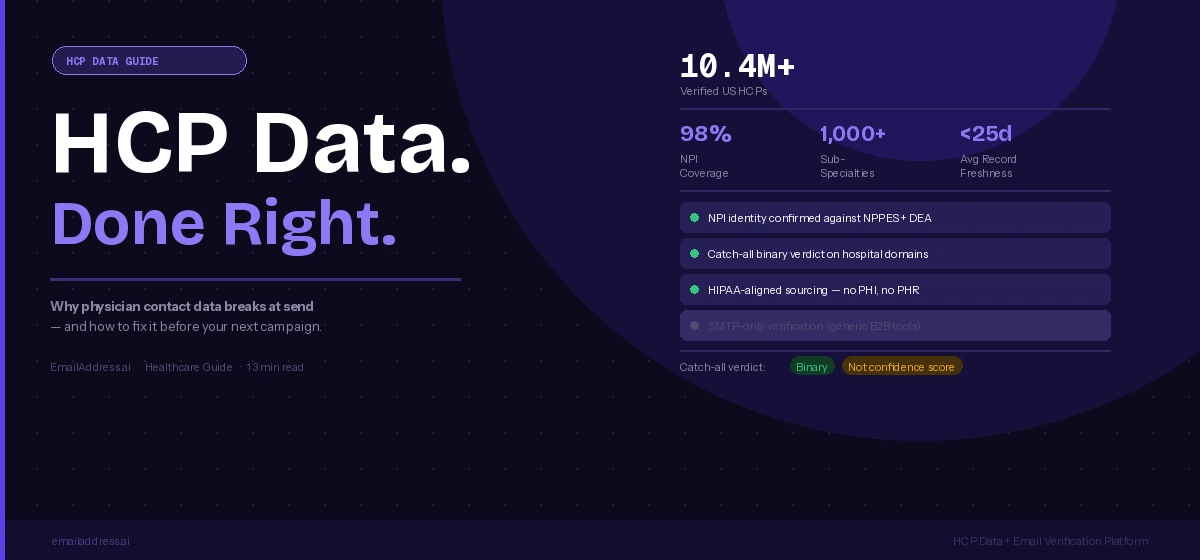
EmailAddress.ai verifies every HCP record against NPI registry data, DEA records, and state medical board sources on a continuous monthly cycle. That gives us 98% NPI coverage with an average record freshness under 25 days. When you send to a physician contact from our database, you send to someone whose identity we confirmed against live government sources – not just someone whose email passed an SMTP check six months ago.
What does NPI-verified HCP data actually mean?
NPI-verified HCP data means each contact record has a match to an active National Provider Identifier in the CMS NPPES registry – confirming the physician’s identity, specialty classification, and practice status. True NPI verification goes beyond matching a name and number. It confirms the physician currently holds a license, practices in the identified specialty, and is reachable at the contact information on file. Providers who claim NPI verification but only match names without checking active practice status describe a significantly weaker process than what that phrase implies.
The Catch-All Problem Is Bigger Than You Think
In a general B2B database, catch-all domains are an inconvenience. You flag them, segment them, and run a separate low-volume test send. But in HCP outreach, catch-all domains are a structural problem that affects a significant portion of your list before you send a single message.
Major health systems, hospital networks, and academic medical centers – the exact institutions where high-value physicians practice – run disproportionately as catch-all mail servers. This niche edge case framing misses the scale of the problem. It is a central feature of how healthcare IT infrastructure works. An orthopedic surgeon at a major academic medical center is likely reachable at a catch-all domain. So is a cardiologist at a regional health system. So is the pharmacy director at a hospital network your medtech team needs to reach.
Most verification tools handle this by returning a “catch-all” or “unknown” classification and leaving the decision to you. That answer does not help when you are building a campaign list under deadline. You need a binary answer.
EmailAddress.ai’s catch-all verification layer goes beyond the SMTP handshake. We apply identity verification on every lookup – confirming that the specific physician at that NPI currently works at that institution – before we return a deliverable verdict. The result is a binary deliverable or not deliverable status on catch-all healthcare domains, not a probability score. That means you send to addresses we have confirmed, and you do not send to addresses we have not. Your bounce rate reflects the quality of the verification, not your tolerance for risk.
Where EmailAddress.ai Fits in Your Enrichment Stack
Most healthcare commercial teams draw from multiple data sources, not just one. They run enrichment stacks – pulling contact data from one provider, running it through a verification layer, appending specialty and practice setting from a second source, and feeding clean records into Salesforce, Veeva, or HubSpot. That is the right approach. Single-source data pipelines break for the same reason single-source verification breaks: no one provider has everything, and stale data from any layer degrades the whole stack.
EmailAddress.ai works as the verification and identity confirmation layer at the end of your enrichment waterfall. Your existing data pipeline – whether that is a purchased specialty list, a CRM export that needs refreshing, or records coming out of a sales intelligence tool – runs through our NPI verification and catch-all detection layer before it reaches your ESP. What goes into your sending queue we have identity-confirmed and delivery-vetted. What does not make it through receives a flag with a reason, rather than passing silently as a deliverable risk.
For teams using Clay or similar enrichment workflow tools, this integration pattern is straightforward: EmailAddress.ai sits as the healthcare verification step between your data acquisition step and your CRM sync – the step that other providers cannot replicate.
How does EmailAddress.ai differ from IQVIA, Veeva OpenData, and Definitive Healthcare?
IQVIA OneKey, Veeva OpenData, and Definitive Healthcare are enterprise compliance and market intelligence platforms. They handle CRM master data management, formulary tracking, procedure volume analysis, and territory planning at scale – typically under multi-year enterprise contracts. EmailAddress.ai, by contrast, focuses specifically on outreach-ready HCP contact data: NPI-verified physician emails with catch-all binary verdicts, specialty sub-classification across 1,000+ categories, and no enterprise contract requirement. The categories complement each other. Use intelligence platforms to identify your targets. Instead, use EmailAddress.ai to reach them.
What Real HCP Engagement Strategy Looks Like
Data quality is table stakes. It is the foundation. But the teams that get results from HCP outreach do more than run cleaner lists. They are building engagement strategies that layer real buying signals on top of verified contact data – and those two things have to work together.
We see two failure modes constantly. The first is teams with great strategy and bad data. Their targeting logic shows real sophistication. Their messaging is well-segmented by specialty and prescribing behavior. However, the contact data underneath does not hold up – high catch-all rates, stale NPI records, wrong practice settings. The campaign collapses at delivery.
The second failure mode is teams with clean data and no strategy. They have a verified list of 50,000 oncologists. Then they send the same email to all of them. So engagement stays flat.
The teams that perform consistently treat the data as a platform to build on, not a commodity to blast through.
Specialty and Sub-Specialty Segmentation
Oncology covers multiple distinct audiences. Surgical oncology, medical oncology, and radiation oncology have different decision-making patterns, different engagement habits, and different relationships with pharmaceutical commercial teams. Because of this, a campaign built on 39 broad specialty groups will underperform a campaign built on the relevant sub-specialties for that indication.
EmailAddress.ai covers 39 specialty groups and more than 1,000 sub-specialties across 10.4 million verified US healthcare professionals. That granularity goes beyond a number – it is the difference between messaging that lands and messaging that misses. A medtech sales team targeting interventional cardiologists for a structural heart device does not need a list of all cardiologists. They need interventional cardiologists at institutions with the procedural volume to actually use the device.
Practice Setting as a Targeting Signal
Where a physician practices tells you a lot about how they make decisions. A physician in private practice has different purchasing authority than a hospital-employed physician working inside an IDN. Similarly, a physician at an academic medical center operates under different formulary and purchasing constraints than one in a community practice setting.
Practice setting data, when accurate and current, is one of the most underused targeting signals in HCP engagement. Most teams filter by specialty. However, fewer filter by specialty plus practice setting plus NPI-confirmed employment status. That combination narrows your list. But it improves every downstream metric.
Engagement Sequencing That Matches the HCP’s Reality
Physicians behave differently from any other B2B audience. They do not sit at a desk checking email between meetings. So they move between patients, rounds, and surgery. A physician who skips your email on Tuesday morning may simply have been unavailable – they may have been in the OR. Because of this, engagement sequencing for HCP outreach needs to account for irregular availability and much longer decision cycles than typical B2B outreach.
What works: shorter initial messages, lower send frequency, subject lines that signal immediate clinical or practice relevance, and patience. What does not work: a seven-email drip sequence modeled on SaaS sales cadences applied to a medical oncologist’s inbox.
The Compliance Question: Answered Directly
HIPAA does not restrict pharma or medtech companies from emailing physicians for commercial purposes. This is one of the most persistent compliance misconceptions in healthcare marketing, and it costs teams real campaign time while they wait for legal review on a question that was already settled.
HIPAA governs the use of patient health information. A physician’s professional contact information – name, NPI, specialty, practice address, business email – does not qualify as protected health information. EmailAddress.ai sources all HCP contact data from HIPAA-aligned sources: the NPI registry, licensed partner agreements, and professional directories. No clinical system access, no patient records, and no PHI.
CAN-SPAM applies to commercial email outreach to physicians just as it does to any B2B campaign. The requirements are straightforward: accurate sender identification, a physical address, a functioning opt-out mechanism, and honoring opt-outs within 10 business days. For teams reaching EU-based physicians, GDPR legitimate interest under Article 6(1)(f) applies to professional B2B communications when a genuine commercial connection exists – the ICO guidance on this is explicit. Under legitimate interest, EU physician outreach does not require consent-based opt-in. Conflating GDPR with CAN-SPAM is a common compliance mistake that unnecessarily limits outreach scope.
What permitted use restrictions should I check in an HCP data license?
Before signing any HCP data licensing agreement, your legal and marketing ops teams should confirm: (1) outreach use rights – can you send campaigns directly from this data or only use it for CRM enrichment? (2) sub-licensing terms – if you are an agency or platform, can you forward the data to end users or clients? (3) territory rights – does the license cover US only or international physician contacts? (4) retention terms – are you required to delete records when the license expires? (5) refresh obligations – does the provider commit to update frequency and accuracy standards in writing? Providers who cannot answer these questions in a standard contract typically lack the compliance infrastructure that pharma and medtech legal teams require for approval.
Why Generic B2B Data Breaks for Healthcare
ZoomInfo and Apollo target technology and SaaS go-to-market. They are good at what they do. But their physician coverage reflects the limitations of their sourcing model: minimal NPI verification, no catch-all binary verdict for health system domains, specialty taxonomy that tops out at broad categories, and no continuous monitoring against NPPES and state medical board data.
When a medtech sales team uses a general B2B data tool for HCP outreach, they put unrefined data into a campaign that needs something much more specific. The contact data never targeted the quality requirements of physician outreach. The verification process does not handle catch-all hospital domains. The specialty data lacks the granularity for sub-specialty targeting. And when the bounces come back, there is no identity layer to explain why.
EmailAddress.ai, by contrast, targets healthcare outreach specifically. We measure our 96.4% email verification accuracy against active HCP send data, not just SMTP responses. Our catch-all verdict is binary because we apply identity confirmation before returning a deliverable status. And our specialty taxonomy supports more than 1,000 sub-specialty filters because HCP campaigns require that precision to perform.
Key Sources
- CMS NPPES National Provider Identifier Registry: cms.gov
- FTC CAN-SPAM Act Compliance Guide: ftc.gov
- HHS HIPAA for Professionals: hhs.gov
- ICO Legitimate Interests under UK GDPR: ico.org.uk
Frequently Asked Questions
What is HCP data used for in pharma and medtech marketing?
HCP data pharma and medtech commercial teams use HCP data commercial teams to identify, verify, and reach licensed healthcare professionals for email campaigns, territory planning, formulary engagement, and account-based marketing. The most common use cases include specialty-segmented email campaigns to physicians, rep-led outreach to target prescribers, and medtech sales to clinical decision-makers at hospitals and health systems. A quality HCP record carries verified email addresses, NPI numbers, specialty classification, and practice setting confirmation – not just names and titles scraped from a directory.
How often should HCP contact data be refreshed?
HCP contact data needs a refresh at minimum monthly. Physician records change frequently: NPI status updates when physicians retire, relocate, or change specialty designations; practice affiliations shift as health systems acquire independent practices; and email addresses change when physicians move institutions. A provider that refreshes annually or quarterly cannot maintain the accuracy standards required for reliable HCP outreach. EmailAddress.ai runs continuous NPI monitoring with a full database refresh cycle averaging under 25 days between record updates.
What is the difference between HCP data licensing and buying a physician list?
Buying a physician list typically means a one-time purchase of a static contact file with no refresh, no usage rights documentation, and no verification methodology disclosure. HCP data licensing is a structured commercial arrangement specifying permitted use – outreach, CRM population, enrichment, sub-licensing – along with refresh terms and sourcing documentation that pharma legal teams require for campaign approval. Licensed HCP data from a compliant provider includes that documentation. A purchased list usually does not include it.
Why do hospital domain emails show high bounce rates even after verification?
Hospital domain emails bounce at higher rates after standard verification because major health system and academic medical center domains are frequently configured as catch-all mail servers. A catch-all server accepts all incoming SMTP connections regardless of whether the individual mailbox exists – so basic verification returns a valid result even on inactive or nonexistent addresses. The solution is identity verification layered on top of SMTP checking: confirming the specific physician at that NPI currently works at that institution before returning a deliverable verdict. This is the approach EmailAddress.ai uses to produce a binary deliverable or not deliverable verdict on catch-all healthcare domains.
Can pharma companies email physicians without violating HIPAA?
Yes. HIPAA does not restrict pharma or medtech companies from sending commercial emails to physicians using their professional contact information. HIPAA governs protected health information, which does not include a physician’s business email address, NPI number, or professional specialty. Commercial outreach to physicians falls under CAN-SPAM in the United States, which requires accurate sender identification, a physical mailing address, and a functional opt-out mechanism. GDPR governs campaigns to EU-based physicians, with legitimate interest under Article 6(1)(f) covering professional B2B communications in most circumstances.
How is EmailAddress.ai different from IQVIA or Definitive Healthcare?
IQVIA OneKey, Veeva OpenData, and Definitive Healthcare focus on market intelligence and CRM compliance – formulary tracking, territory analytics, and claims data analysis under multi-year enterprise contracts. EmailAddress.ai, by contrast, is an outreach-ready HCP contact data platform: NPI-verified physician emails with catch-all binary verdicts, sub-specialty filters across 1,000+ categories, and no enterprise contract requirement. The categories serve different needs. Intelligence platforms help you identify and understand your targets. EmailAddress.ai gives you the verified contact data to reach them.
Build Your HCP Outreach on Data That’s Actually Been Verified
The difference between an HCP campaign that delivers and one that bounces is not about strategy. It is the foundation. Verified physician contact data – NPI-confirmed identity, catch-all binary verdict, sub-specialty precision, monthly refresh – drives everything else to perform. EmailAddress.ai gives pharma and medtech commercial teams 10.4 million verified US healthcare professionals across 39 specialty groups and 1,000+ sub-specialties, with no multi-year enterprise contract required.
If your current HCP data generates bounce rates above 5% or catch-all uncertainty above 20% of your list, the foundation is the problem. So start there.
See our HCP data coverage by specialty – or request a sample for your target therapeutic area.
Transparency note: EmailAddress.ai provides the HCP contact data described in this guide. All capability claims reflect our current verified database as of June 2026.
Written by the EmailAddress.ai Editorial Team
Related Reading:
The Complete Guide to Catch-All Email Verification
Catch-All Verification for HCP Campaigns
HCP Data Providers Compared: 2026 Guide