
14 min read | Last Updated: May 2026
Your pharma brand manager just got back from a vendor demo. IQVIA quoted a six-figure annual contract. Definitive Healthcare wants three years upfront. Veeva OpenData requires you to already run Veeva CRM. And somewhere in that conversation, nobody answered the real question: which HCP data provider actually delivers verified physician email addresses ready for campaign deployment?
That disconnect sits at the heart of how pharma and medtech teams evaluate HCP data providers in 2026. Most well-known platforms focus on market intelligence, claims analytics, and CRM reference data. They do those things well. But when your use case is outreach-ready HCP contact data with verified emails and no three-year lock-in, you’re often buying the wrong product.
This guide covers the four most commonly evaluated HCP data provider platforms. It covers pharma marketing, medical device, and healthcare technology commercial teams. It maps what each platform does best, where each falls short for direct outreach, and how to select the right fit.
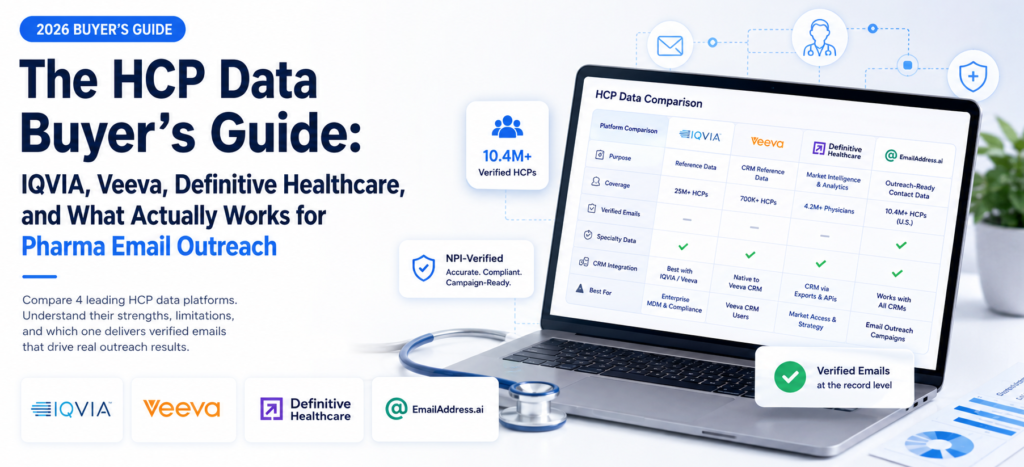
Quick answer: The best HCP data provider for pharma email outreach depends on your use case. IQVIA OneKey and Veeva OpenData are enterprise reference databases built for CRM master data management – not direct campaigns. Definitive Healthcare is a market intelligence analytics platform. EmailAddress.ai provides NPI-verified, outreach-ready HCP contact data with email verification and specialty filtering. No multi-year contract is required, making it the most accessible option for pharma marketing and medical device teams.
What HCP Data Actually Is – and Why the Definition Matters for Vendor Selection
“HCP data” gets used loosely to describe everything from a basic physician contact list to a fully integrated commercial intelligence platform. That gap matters enormously when you evaluate vendors. Two providers can both claim to offer “HCP data” while delivering fundamentally different levels of commercial value.
Four distinct categories exist that buyers regularly conflate:
HCP reference data: Master data management – NPI-linked records, compliance flags, affiliations. This powers CRM systems and maintains a single source of truth. IQVIA OneKey and Veeva OpenData dominate this category.
Healthcare market intelligence: Claims data, procedure volumes, Rx patterns, org hierarchy, prescribing deciles. Teams use this for market sizing, territory planning, and target identification. Definitive Healthcare leads here.
HCP contact data for outreach: Verified direct email addresses, phone numbers, and specialty filters attached to NPI-verified physician records. EmailAddress.ai provides this – 10.4 million verified US healthcare professionals across 39 specialty groups and 1,000+ sub-specialties. Email verification is built in at the record level.
KOL and medical affairs intelligence: Key opinion leader mapping, publication records, clinical trial participation, peer influence networks. Specialist platforms serve this category separately.
Most buyer confusion happens at the intersection of categories one and three. Teams need physician email addresses for a product launch. They evaluate the biggest names and get quoted five-figure minimums for platforms built around reference data and analytics. They either overspend on capabilities they’ll never use or walk away without solving the original problem.
Identifying which category matches your actual use case is the most important step in any HCP data provider evaluation. The 15 pharma campaign types that use licensed HCP data maps specific data requirements to specific campaign types. It’s a useful starting point before approaching any vendor.
IQVIA OneKey: Enterprise Scale, Enterprise Requirements
IQVIA OneKey is the largest HCP reference database in the world. The platform covers more than 25 million HCPs globally. It includes approximately 1.2 million US physicians across 248 specialties and 6 million healthcare organizations in 118 countries. Each record contains over 1,000 data attributes. The database receives more than 1.5 million updates each month. IQVIA is ISO 9001 certified and audited by the Alliance for Audited Media.
What IQVIA OneKey is genuinely strong for:
- Enterprise pharma companies managing global field force operations across multiple markets
- CRM master data management requiring a single authoritative physician identity source
- Regulatory compliance workflows where data provenance and audit trails are mandatory
- Medical affairs teams mapping KOL networks and publication histories at scale
Where IQVIA OneKey falls short for outreach-focused teams:
OneKey is most useful inside the IQVIA ecosystem or connected to Veeva CRM. Teams running Salesforce, HubSpot, or custom CRM environments encounter real integration friction. The platform was designed for large pharmaceutical enterprises managing thousands of field interactions monthly. A specialty pharma team targeting one therapeutic area in three states does not need OneKey. The pricing reflects those enterprise requirements.
Critically, OneKey functions as a reference database, not an outreach tool. IQVIA includes email addresses as reference fields, but it does not verify them for active deliverability or catch-all domain resolution. So a field that passes IQVIA’s reference validation can still bounce at 25% or more when you deploy a campaign to hospital-domain physician addresses.
Definitive Healthcare: Market Intelligence, Not Campaign Fuel
Definitive Healthcare is a publicly traded analytics firm (Nasdaq: DH) with approximately 3 million US HCP profiles. It covers 310,000 healthcare organizations. The platform’s strength is market intelligence. It links clinical claims data, procedure volumes, Rx patterns, and organizational hierarchy into a commercial intelligence layer. Pharma and medtech teams use this to size markets, identify high-value targets, and understand IDN buying structures.
What Definitive Healthcare is genuinely strong for:
- Market sizing and opportunity analysis before a product launch
- Territory planning using procedure volumes and referral patterns within IDNs
- Identifying decision-maker structures inside IDNs and GPOs
- Claims-based segmentation to find high-decile prescribers in a therapeutic area
Where Definitive Healthcare falls short for outreach-focused teams:
Definitive Healthcare’s analytics capabilities do not extend to its outreach infrastructure. Email coverage rates vary significantly by specialty. Teams that need high email coverage for campaigns frequently find gaps, particularly for hospital-employed specialists. The platform includes no catch-all detection, no identity verification, and no SMTP-level inbox validation as standard. Because of this, teams that use Definitive to identify target physicians still need a separate verified contact data source to reach them by email.
Procurement friction compounds the problem. End-of-quarter pressure tactics and complex contract structures appear widely in G2 and TrustRadius reviews. For mid-market pharma and medtech teams, these dynamics create real barriers. Definitive Healthcare reported a 7% year-over-year revenue decline in Q1 2025. Teams that evaluate alternatives now have real options in 2026 that did not exist three years ago.
Veeva OpenData: Built for Veeva CRM Users
Veeva OpenData is Veeva Systems’ managed HCP reference data service. It covers over 12 million HCPs globally across 300+ pharma and medtech customers. Like IQVIA OneKey, it is built around master data management. A clean, compliance-validated source of physician identity powers field force tracking, sample management, and regulatory reporting inside Veeva CRM.
What Veeva OpenData is genuinely strong for:
- Organizations already running Veeva CRM as their core field force platform
- Compliance-sensitive data workflows requiring documented data lineage
- Global enterprise field force operations inside the Veeva ecosystem
Where Veeva OpenData falls short for outreach-focused teams:
Veeva OpenData is not a standalone product. Its value depends almost entirely on operating inside the Veeva ecosystem. The specific ways Veeva CRM HCP data quality degrades over time apply regardless of whether OpenData feeds the system. NPI field gaps, specialty label breadth, and institutional email decay are all common failure modes. Email addresses in OpenData confirm that a physician exists at a location. However, Veeva does not validate them for campaign deliverability. So teams that need outreach-ready verified contact data still require a separate verified email layer.
EmailAddress.ai: HCP Contact Data Built for Outreach
EmailAddress.ai is an AI-powered email verification and HCP contact data platform. It serves pharma marketing teams, medical device companies, and healthcare technology vendors. The platform covers 10.4 million verified US healthcare professionals across 39 specialty groups and 1,000+ sub-specialties. Email verification is integrated at the record level.
The difference from reference data and analytics platforms is not scale. It is purpose. Every record in the EmailAddress.ai HCP database serves campaign deployment, not CRM reference or claims analytics.
The verification methodology runs five layers:
- NPI registry validation: EmailAddress.ai verifies 98% NPI coverage against CMS NPPES, DEA registration, and state medical board records. This runs across all 50 states. Every US physician record matches an active NPI before it enters the database.
- SMTP inbox verification: Active inbox validation confirms each email routes to a live, monitored mailbox. It filters out defunct practice addresses and institutional emails that have gone unmonitored for years.
- Catch-all domain resolution: Hospital domains accept all incoming email regardless of whether the individual mailbox exists. EmailAddress.ai resolves these through behavioral analysis and network pattern recognition. The result is a binary verdict – deliverable or undeliverable – rather than a confidence score that forces your team to guess. The catch-all verification process for HCP campaigns is documented in full.
- Identity verification: The system confirms the physician at that NPI still works at that institution in that role. This step catches physicians who have retired, relocated, or changed practice settings. Standard verification tools skip this entirely. EmailAddress.ai includes it on every record as standard.
- Continuous refresh: Records refresh monthly, with an average record age under 25 days. Rather than waiting for a quarterly batch update, NPI status changes receive continuous monitoring.
The output is 96.4% email verification accuracy across the healthcare database. Coverage spans physicians, registered nurses, nurse practitioners, physician assistants, pharmacists, behavioral health practitioners, and allied health professionals. Current live contact counts by specialty and state are available through the healthcare data intelligence dashboard before any commercial commitment.
HCP Data Provider Comparison: What Each Platform Actually Delivers
The table below maps each platform’s actual capabilities against the criteria that determine campaign performance – not the criteria vendors use in their own marketing.
Platform Capability Comparison at a Glance
Capability IQVIA OneKey Definitive Healthcare Veeva OpenData EmailAddress.ai
Primary use case CRM reference / field force Market intelligence / claims CRM reference / Veeva ecosystem Direct email outreach / campaign deployment Built for email outreach No No No Yes NPI verification depth High (reference grade) Moderate High (reference grade) High – 98% NPPES + DEA + state boards SMTP inbox verification No No No Yes Catch-all domain resolution No No No Yes – binary deliverable / undeliverable Identity verification No No No Yes – confirms person behind the email Specialty sub-category depth 248 specialties Moderate Moderate 1,000+ sub-specialties / 39 groups Average record freshness Not disclosed Real-time (claims-linked) Not disclosed Under 25 days Global HCP coverage 25M+ / 118 countries 3M+ US primary 12M+ global 10.4M US + 200+ countries Multi-year contract required Yes Yes Yes No HIPAA-aligned sourcing Yes Yes Yes Yes – NPI registry + licensed partners, no PHI
The HCP Deliverability Problem Most Vendors Don’t Mention
Why Hospital Domains Create a Hidden Campaign Risk
Hospital-employed physicians represent over 60% of specialists in cardiology, oncology, and surgery. They operate from institutional email addresses. Those addresses sit on hospital domains configured as catch-all – the server accepts all incoming email regardless of whether the individual mailbox exists or receives monitoring.
This creates a problem that reference data and analytics platforms do not solve. A physician’s email address can pass NPI validation and appear in a reputable database. But it can still generate a bounce when your campaign deploys. The institutional address may route to an unmonitored shared mailbox. The physician may have left that hospital six months ago. Or the hospital’s enterprise email gateway may silently reject external commercial senders.
According to HHS HIPAA guidance, physician outreach using professional contact data for pharma marketing does not implicate HIPAA’s Privacy Rule. The compliance concern sits at the data sourcing layer, not the campaign layer. However, the deliverability problem is real and entirely separate from compliance. Sending to unverified hospital email addresses damages sender domain reputation. That damage compounds across subsequent campaigns regardless of how clean your content is.
The HCP email deliverability and bounce rate benchmarks document the specific failure modes by domain type and specialty. They explain why hospital-domain bounce rates run higher than expected even on lists sourced from major reference databases.
How to Choose the Right HCP Data Provider for Your Team
The right HCP data provider depends on your actual use case, not on brand recognition. Most brand recognition in this space belongs to platforms that serve enterprise pharma requirements. Mid-market commercial teams simply don’t have those requirements.
Match the Platform to the Use Case
If you need CRM master data management and compliance tracking for a large field force: IQVIA OneKey or Veeva OpenData, depending on your CRM ecosystem. Expect enterprise procurement timelines and pricing to match.
If you need market intelligence, prescribing analytics, and IDN org hierarchy for territory planning: Definitive Healthcare works here, although the contract complexity and pricing require realistic budget expectations upfront.
If you need verified physician email addresses for campaign deployment – a drug launch, CME program, medical device outreach, or clinical trial recruitment – without a six-figure enterprise contract: EmailAddress.ai solves this directly. The HCP data licensing platform covers the full range of pharma and medtech outreach use cases.
Run a Sample Check Before You Commit
Before committing to any vendor, request a sample of 50-100 records for your target specialty and state. Run them through an independent inbox validation tool. Then cross-reference a subset against the CMS NPI registry. That 10-minute check reveals more about actual data quality than any vendor presentation.
What to Ask Every HCP Data Vendor Before You Sign
- What is your NPI verification methodology? A database that cross-references NPPES, DEA, and state medical boards separately is more reliable than one using a single registry pass. Ask for specifics, not a general claim.
- How do you handle catch-all hospital domains? If the answer is a confidence score rather than a binary verdict, your team absorbs that ambiguity as bounce rate risk on every campaign.
- Do you include identity verification – confirming the person behind the email still works at that institution? Most vendors skip this step entirely. Yet it is the most common source of physician list decay between purchase and deployment.
- What is your average record age at point of delivery? Quarterly refresh means records can be up to 90 days stale when they reach you. Monthly refresh with continuous NPI monitoring brings that average under 25 days.
- Can I verify a sample against the CMS registry before committing? Any vendor who declines this request signals something important about their data quality confidence.
- What are the actual contract terms? Multi-year commitments make sense for CRM master data management. For campaign-specific outreach, however, they represent a cost structure that doesn’t match the use case.
Frequently Asked Questions
What is an HCP data provider?
An HCP data provider maintains and licenses verified contact and professional information about healthcare professionals. This covers physicians, nurses, pharmacists, and allied health practitioners. Teams use this data for pharma marketing, medical device sales, clinical trial recruitment, and healthcare technology programs. HCP data typically includes NPI numbers, specialty classifications, direct email addresses, phone numbers, and practice locations. Because physician career transitions occur continuously, quality HCP data requires regular refresh. Specialist physician lists experience approximately 6% annual email address decay.
What is the difference between IQVIA OneKey and an HCP email list?
IQVIA OneKey is a reference database built for CRM master data management at enterprise pharmaceutical companies. An HCP email list, by contrast, is a verified set of physician email addresses validated for active deliverability and campaign deployment. The two products serve different operational needs. IQVIA OneKey includes email as a reference field. However, the platform does not run SMTP-level inbox verification, catch-all domain resolution, or identity verification. An outreach-ready HCP email list includes all three. Teams deploying physician email campaigns typically need both – or they evaluate whether a purpose-built outreach platform removes the need for a reference database entirely.
Is it legal to email physicians for pharma marketing?
Yes, with specific conditions. HIPAA’s Privacy Rule governs the handling of patient health information. It does not restrict pharmaceutical companies from contacting physicians for marketing using professional contact data. The applicable regulation for B2B email outreach to US physicians is CAN-SPAM. It requires a functioning opt-out mechanism, accurate sender identification, and a physical postal address in every message. No prior consent is required under CAN-SPAM. GDPR applies separately for outreach to EU-based physicians. There, legitimate interest under Article 6(1)(f) provides the standard legal basis for professional B2B communications.
How often should HCP contact data be refreshed?
Monthly refresh is the minimum standard for outbound-active pharma and medtech teams. Physician career transitions occur continuously – hospital employment changes, practice relocations, retirement. AMA workforce data indicates that 30% of physicians change practice settings within five years. This generates annual email decay roughly double that of standard B2B contact lists. While quarterly refresh cycles leave physician lists stale before deployment, monthly refresh with continuous NPI monitoring keeps average record age under 25 days. EmailAddress.ai operates on this monthly cycle with continuous NPI monitoring between batches.
What makes EmailAddress.ai different from other HCP data providers?
EmailAddress.ai combines NPI-verified HCP contact data with email verification at the record level. Every physician email address in the database receives validation for active deliverability, catch-all domain resolution, and identity verification before delivery. Most HCP data platforms treat contact data and email verification as separate products, or they skip inbox-level verification entirely. EmailAddress.ai includes identity verification as standard on every record. It confirms that the physician at the listed NPI still works at that institution in that role. The platform covers 10.4 million US healthcare professionals across 39 specialty groups and 1,000+ sub-specialties, with no multi-year contract requirement.
What is the best HCP data provider for medical device companies?
Medical device companies need verified surgical specialist contacts segmented by procedure volume and hospital affiliation. Prescribing data is less relevant here. Because IQVIA and Definitive Healthcare focus primarily on prescribing analytics, they are less suited to device targeting. EmailAddress.ai covers surgical specialties across 33 sub-categories with NPI verification and SMTP-level inbox validation. Since the platform does not require a multi-year enterprise contract, it works well for mid-market and growth-stage medtech commercial teams.
Key Takeaways
- HCP data is not one product category – reference data, market intelligence, and outreach-ready contact data are three different things solving three different commercial problems
- IQVIA OneKey and Veeva OpenData are reference databases built for enterprise field force management, not email campaign deployment
- Definitive Healthcare is a market intelligence platform with strong claims analytics – it is not an outreach-ready physician email database
- Hospital domains are frequently catch-all configurations – email verification that returns a confidence score rather than a binary verdict transfers the bounce risk to your campaign
- Identity verification – confirming the physician at that NPI is still at that institution – is the step most HCP data vendors skip and the most common source of physician list decay
- Monthly refresh with continuous NPI monitoring is the data freshness standard that prevents physician career transitions from becoming campaign bounce rate problems
- EmailAddress.ai provides NPI-verified, outreach-ready HCP contact data with email verification built in, no multi-year contract, and average record freshness under 25 days
Ready to see verified HCP coverage for your target specialty before any commitment? Explore EmailAddress.ai’s HCP data licensing platform or review live contact counts by specialty and state in the healthcare data intelligence dashboard.
Written by the EmailAddress.ai Data Intelligence Team
Our team has worked with pharma commercial ops, healthcare marketing agencies, and medical device companies for over a decade. We specialize in NPI-verified HCP data, specialty-level physician targeting, and compliant healthcare data licensing across global markets.